Chinese President Xi Jinping has strong nerves
The red carpet was rolled out at the US Joint Base Andrews. President Donald Trump stood with his guest, Chinese President Xi Jinping. The cameras were focused on the two leaders when suddenly the roar of US military aircraft shook the air.
As the planes passed overhead to greet him, Trump frowned at the roar of the planes and bowed his head for a moment. But the face of the strong-willed Chinese President Xi Jinping, who was standing next to him, did not change even slightly. Tolerating the roar of the warships in such a calm manner is a sign of his strong nerves. Another sign of the strong nerves of the Chinese President is that no one can guess from his face and eyes what he is thinking and what decision he is going to make soon. However, this reaction of the Chinese President forced me to learn more about his life.
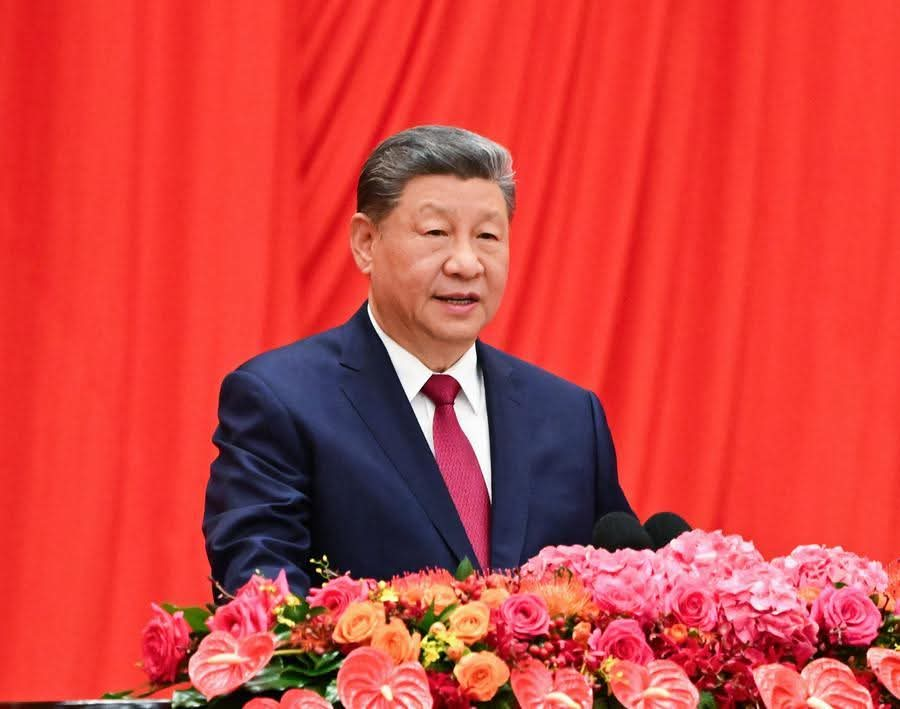
Xi Jinping was born in Beijing on June 15, 1953
Xi Jinping was born in Beijing on June 15, 1953. His father, Xi Zhongxun, was one of China’s most important leaders. His early childhood years were relatively peaceful, but then the country was convulsed by the Cultural Revolution. His father was subjected to political persecution, his family’s life changed, and his education was also affected. The child, who had opened his eyes in Beijing, had to move away from home at a young age to an environment where comforts were few and every day was a different ordeal.
The place was the village of Liangjia in Shanxi province
The place was the village of Liangjia in Shanxi province. The young Xi lived there with the peasants, working in the fields and experiencing the hardships of rural life. The years spent in the village were not just a difficult period in his life; it was the place where he first saw the needs of ordinary people. Today, when his political personality is discussed, this village comes before the halls of Beijing. The man who rose to the highest seat of power spent part of his youth toiling on the land.
Xi Jinping joined the Communist Party of China
In 1974, Xi Jinping joined the Communist Party of China and took charge of the village party branch. The following year, he went to Tsinghua University in Beijing, where he studied chemical engineering. He later pursued further education at the same university. This turn in his life resembles a scene from a movie: on one side are memories of the hard life in the village, on the other, books, laboratories and new prospects for the future. But even after leaving university, he did not immediately rise to the top leadership of the country.
General Secretary of the Communist Party in 2012
He first held government positions, then took the path of local politics. The administrative journey that began in Zhengding, Hebei Province, spread to Fujian, Zhejiang, and Shanghai. Everywhere he encountered different problems, different people, and different decisions. After this long journey, he became the General Secretary of the Communist Party in 2012 and the President of China in 2013. It took him decades, not months, to reach the capital from the villige
There has been a major anti-corruption
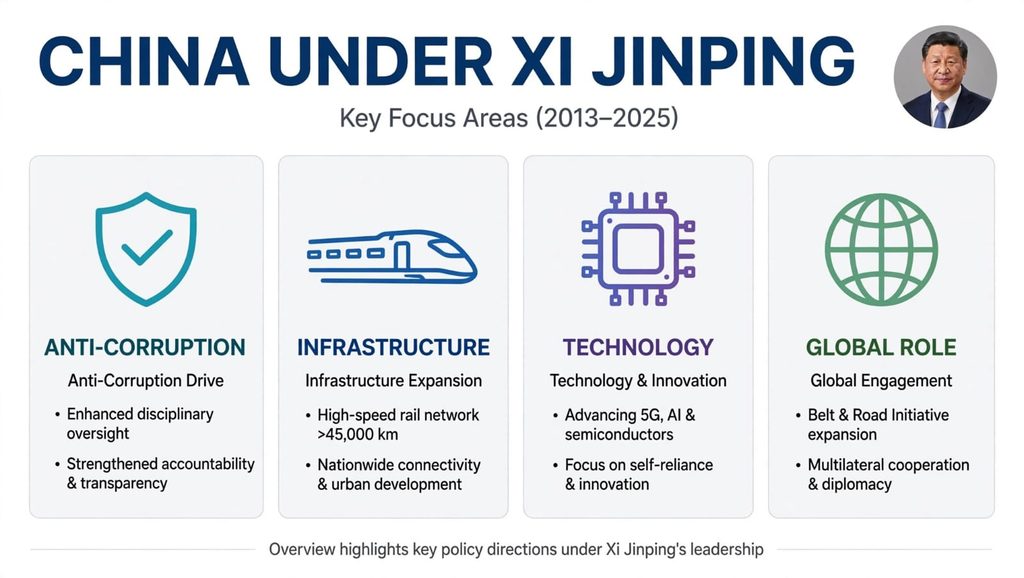
Under Xi Jinping, there has been a major anti-corruption campaign, a focus on infrastructure, industry and technology, and China has increasingly asserted its global role. Through the Belt and Road Initiative, it has sought to expand economic links from Asia to Africa and Europe. Whether it is a trade and technology push with the United States or a dispute over Taiwan, Xi Jinping has had to lead a power that wants to continue its development and protect its interests in the world.
For Pakistanis, Xi Jinping’s story also has its own chapter. In April 2015, he visited Pakistan, addressed the parliament and vowed to give new economic impetus to the China-Pakistan friendship. During his tenure, CPEC invested in energy, roads and other projects. According to the Chinese Foreign Ministry, by the end of 2024, CPEC had brought in about $25.93 billion in direct investment in Pakistan. The port in Gwadar, along with an airport, hospital and other projects, has increased the prospects for development. China is Pakistan’s long-standing partner in defense, while two Pakistani candidates are now undergoing astronaut training in China so that one of them can participate in a future mission to the Chinese space station.
The “Hero of CPEC” by China
Pakistan’s leadership and institutions also play a key role in advancing this cooperation. Prime Minister Shahbaz Sharif has emphasized the next phase of CPEC and the continuation of economic ties with China. Federal Minister for Planning, Professor Ahsan Iqbal, has done a remarkable job in overseeing the projects and coordinating between the two countries; he has been called the “Hero of CPEC” by China. Now the real responsibility is to ensure that the fruits of investment reach the residents of Gwadar, Pakistani industries, and the youth waiting for jobs.
I remember the scene at that American airport again
I remember the scene at that American airport again. The planes roared and passed. The silence on Xi Jinping’s face drew me to his life, but the lesson of his story is greater than this one moment: learning to work in difficult times, working hard for years for a destination, and saving projects from changing governments. If Pakistan learns this lesson of consistency and implementation from China’s experience, the goal of development will not be so far away.