Germany: Military exercises like ‘Red Storm Charlie’ for war preparations
Germany is reviewing its national defense preparations through the “Operations Plan Germany,” while testing these preparations in scenarios closely resembling real-world conditions via military exercises such as “Red Storm Charlie.”
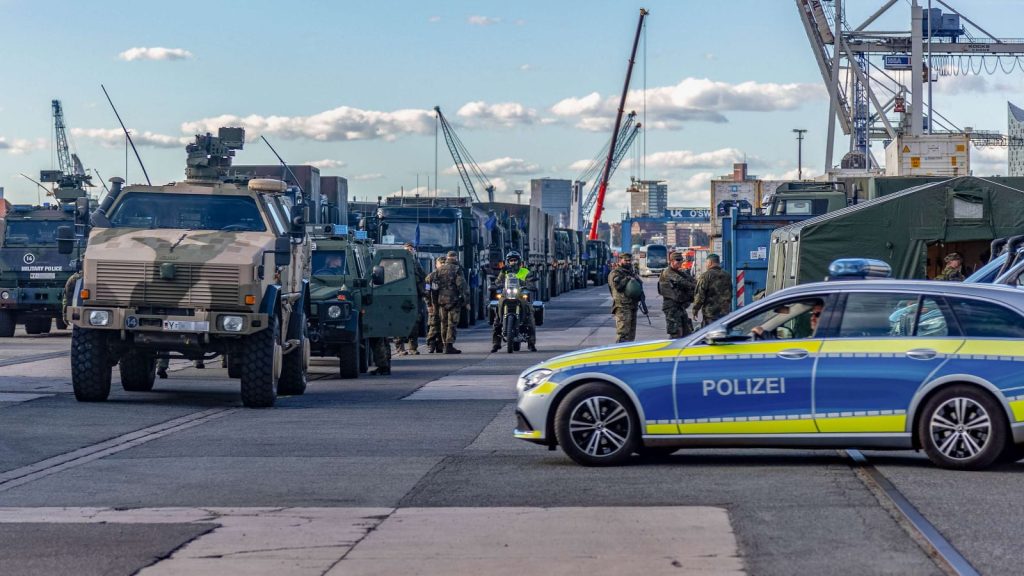
“Red Storm Charlie” is part of a classified strategy known as “Operationsplan Deutschland” (Operations Plan Germany). Under this plan, the German military—the Bundeswehr—is assessing its preparedness for a potential Russian attack against NATO member states. This plan is not limited solely to Germany’s own defense strategy; rather, it serves as a key component of NATO’s broader defense planning system and is aligned with the alliance’s overall defense framework. Its objective is to ensure that, in the event of an emergency or a state of war, Germany and its allies can mount a response in an effective and coordinated manner.
A scenario has been developed for these military training exercises, centered on the deteriorating security situation along NATO’s eastern flank. During the exercise, NATO forces—represented by German troops—arrive at Hamburg, Germany’s largest port, and from there, advance eastward using civilian infrastructure.
The scenario includes acts of sabotage and protest demonstrations, which serve as obstacles to their progress. Held in late September 2026, the exercise involved approximately 1,700 participants, including 500 soldiers, making it the largest exercise of its kind to date.
In the event of a war or a major crisis, not only the city of Hamburg but all of Germany would become a key logistics hub for the movement of hundreds of thousands of NATO troops, weapons, and heavy military equipment.
Ilan Metley, a security expert at the German Council on Foreign Relations (DGAP), told DW, “This is an extremely detailed and strictly confidential plan, which clearly specifies where NATO allies will arrive in Germany, which ports they will use, and which routes they will take to move across the country.”
Germany: A Key Logistics Hub for NATO
Germany is considered a key transit country for the movement of NATO forces. The Baltic states are viewed as the region where, in NATO’s assessment, the risk of a Russian attack is highest. In such a scenario, the 32-member NATO alliance would deploy a large number of troops from its member states to this region.
For this purpose, troops arriving from Southern and Western Europe will have to pass through Germany to reach the Baltic region. According to Marcel Bohnert, an officer in the Bundeswehr (the German armed forces) who was involved in drafting the initial version of the ‘Operations Plan Germany,’ the plan entails facilitating the movement of approximately 800,000 soldiers and 200,000 military and support vehicles through Germany within a six-month period. He stated that these are the figures upon which the planning is based.
This is why Germany is focusing on improving its defense and logistics preparations, in order to ensure the rapid and effective movement of NATO forces in the event of a potential crisis or war.
Threats from Russia are increasing.
German Defence Minister Boris Pistorius has stated that the threat posed by Russia is becoming increasingly clear, serious, and urgent. According to him, an attack involving a drone laden with explosives at the Leipzig/Halle Airport in early August failed purely by chance—an incident for which the German government holds Russia responsible.
On September 23, Pistorius stated in the German parliament (Bundestag): “The threat has become more pronounced. It is serious, immediate, and growing. This is exactly what the Russian president wants. Moscow is testing our response.”
To address this threat, the German military is continuously reviewing and refining its “Operations Plan Germany.” Insights gained from military exercises, such as “Red Storm Charlie,” are also being incorporated into this plan.
Upgrading of roads and bridges is necessary.
To what extent is Germany prepared for its military logistics responsibilities? According to security expert Aylin Matlé, the most significant weakness in this regard is the country’s aging—and in some places, deteriorating—infrastructure.
She argues that Germany must work “much more rapidly and comprehensively” to repair and modernize the bridges, roads, and transport routes required for the movement of troops.
Matlé pointed out that some of this infrastructure dates back to the Cold War era and was not originally constructed with the capacity to handle heavy loads or the transport of modern military equipment.
A major challenge in ensuring the success of this project lies in maintaining a balance between confidentiality and public involvement. To prevent potential sabotage, sensitive information regarding the movement of NATO forces—such as specific routes—must be kept secret. At the same time, the success of the project requires close cooperation among the German military, local and regional authorities, the police, relief organizations, and the general public. According to experts in German military affairs, certain aspects of the project must be made publicly available to secure the support of society, the general public, government ministries, and the government itself.
Following the success of the far-right party AfD in the recent elections in the East German state of Saxony-Anhalt, the debate regarding the confidentiality of the 1,000-page “Operations Plan Germany” has resurfaced. Some security experts have expressed concern that the party—perceived as pro-Russian—could potentially relay sensitive information to Moscow; however, the German Ministry of Defence has clarified that no individual state has access to the complete document. Instead, sensitive information is provided only in limited segments, strictly on a “need-to-know” basis.
According to observers, the rise in hybrid threats has further heightened the importance of maintaining the confidentiality of military plans. Even during the “Red Storm Charlie” exercise in Hamburg, information regarding routes and locations was withheld from accredited journalists until the very last moment, due to concerns about potential sabotage or disruptions.