
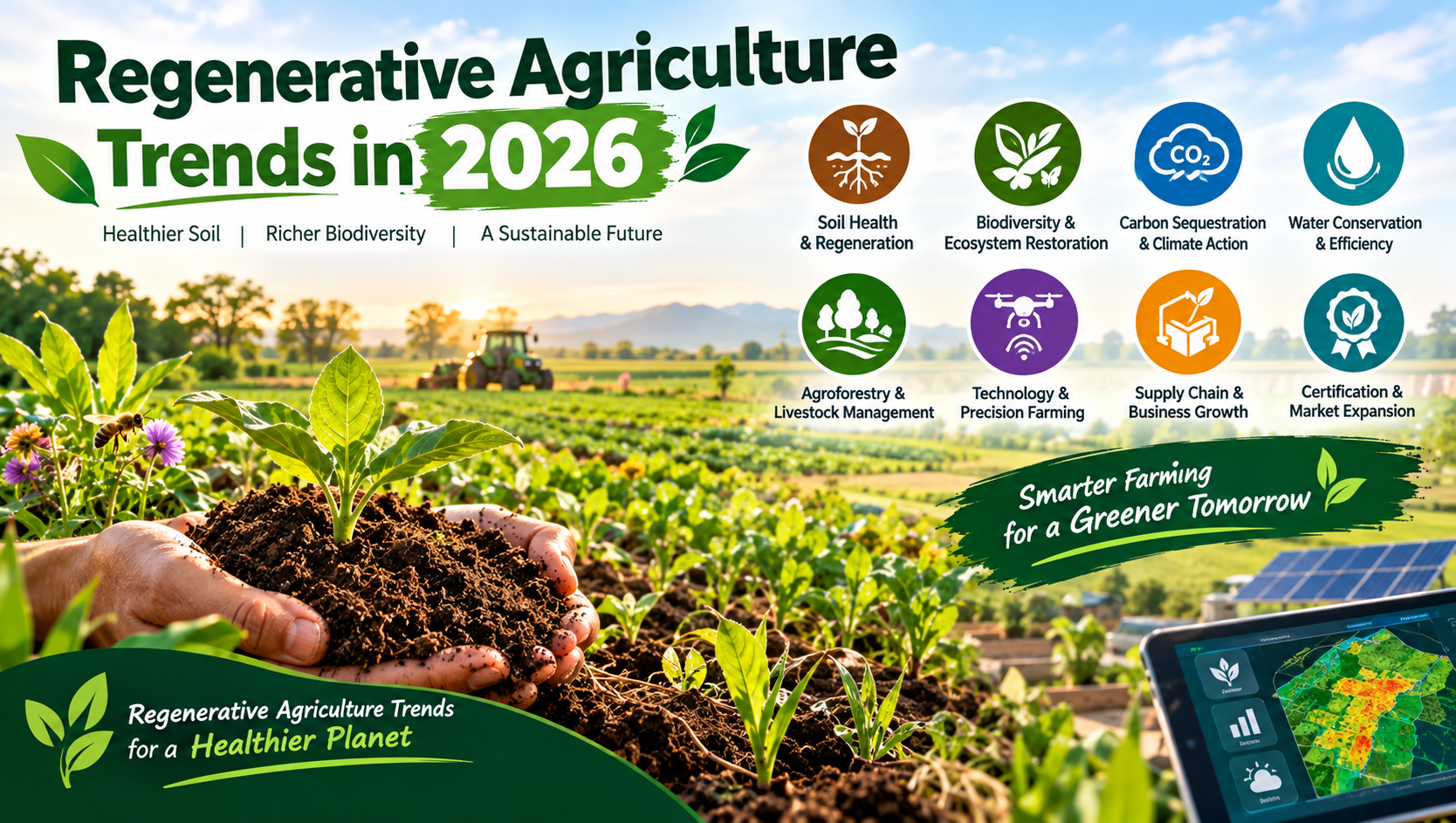
regenerative agriculture trends are changing how farmers think about soil, crops, livestock, water, and long-term food production in 2026. Instead of focusing only on short-term yields, modern farmers are increasingly looking at farming systems that restore natural resources while maintaining productivity and profitability.
The growth of regenerative agriculture trends is also being supported by technology, climate concerns, changing consumer preferences, and new agricultural business models. From soil regeneration and biodiversity to artificial intelligence and carbon farming, these developments are creating new opportunities for farms of different sizes.
Regenerative Agriculture Basics
Regenerative agriculture focuses on improving the health and productivity of farmland over time. Unlike conventional systems that may depend heavily on external inputs, regenerative farming works with natural processes to build stronger ecosystems. The growth of regenerative agriculture trends is making regenerative farming, sustainable agriculture, ecological farming, and nature-positive agriculture more important for sustainable food production.
A major goal is to create resilient agriculture that can handle droughts, heavy rainfall, soil degradation, and changing temperatures. Holistic farming approaches combine crop production, livestock, biodiversity, and natural resources into connected regenerative farming systems. These approaches are becoming important parts of regenerative agriculture trends as farmers search for climate-resilient farming solutions.
Soil Health and Soil Regeneration
Healthy soil is the foundation of productive agriculture. Farmers are paying greater attention to soil organic matter, soil fertility, soil structure, and the soil microbiome. Increasing interest in regenerative agriculture trends is encouraging farmers to improve microbial activity, nutrient cycling, soil carbon, and nutrient availability instead of depending only on synthetic inputs.
Soil regeneration can also improve water retention and reduce erosion. Practices that increase organic matter can help restore degraded land and create healthier soils. As regenerative agriculture trends develop, soil restoration is becoming a long-term investment because better soil can support stronger crops and improve resilience during difficult weather conditions.
Regenerative Farming Practices
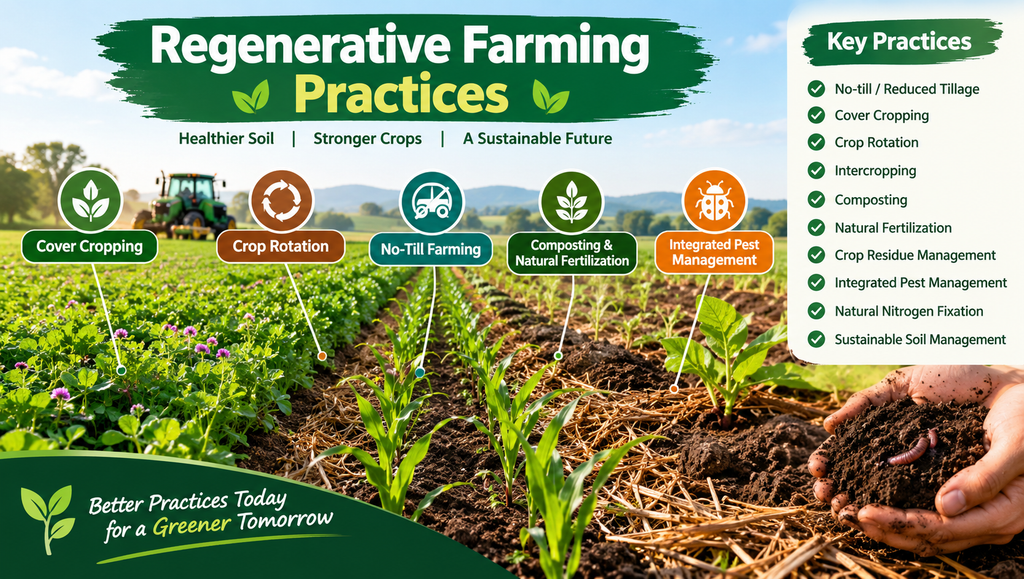
No-till farming and reduced tillage are becoming important practices for protecting soil structure. By disturbing the soil less, farmers can help reduce erosion and preserve soil moisture. The wider adoption of regenerative agriculture trends is also increasing interest in zero tillage and sustainable soil management.
Cover cropping, crop rotation, intercropping, and crop diversity can provide multiple benefits. These practices can protect soil, improve nutrient cycling, support beneficial organisms, and reduce dependence on certain chemical inputs. Within regenerative agriculture trends, composting, natural fertilization, crop residue management, and integrated pest management are also gaining attention.
Biodiversity and Ecosystem Restoration
Agricultural biodiversity is becoming a major part of sustainable farming because diverse farms can provide habitats for beneficial insects, pollinators, birds, and other wildlife. The expansion of regenerative agriculture trends is encouraging farmers to protect natural ecosystems and create better ecological balance around agricultural land.
Ecosystem restoration can include planting diverse vegetation, protecting pollinator habitat, maintaining wildlife habitat, and restoring damaged landscapes. These actions can support biological pest control and improve ecosystem health. As regenerative agriculture trends grow, biodiversity enhancement is increasingly viewed as a productive farming strategy rather than simply an environmental objective.
Carbon Sequestration and Climate Change
Carbon sequestration is one of the most discussed areas of modern regenerative farming. Healthy soils can store carbon through increased organic matter and improved biological activity. The rise of regenerative agriculture trends is bringing greater attention to soil carbon storage, carbon farming, carbon removal, and other approaches for reducing atmospheric carbon.
Climate change is also encouraging farms to become more resilient. Low-carbon farming can reduce greenhouse gas emissions while improving soil and water management. In 2026, regenerative agriculture trends are increasingly connected with climate-smart agriculture, climate adaptation, extreme weather resilience, and carbon-positive agriculture.
Water Conservation and Resource Efficiency
Water scarcity is becoming a serious concern in many agricultural regions. Regenerative approaches can improve water retention by increasing organic matter and strengthening soil structure. The development of regenerative agriculture trends is encouraging farmers to focus on water conservation, soil moisture, drought resilience, and sustainable water management.
Technology is making resource management more efficient. Smart irrigation systems can deliver water according to crop requirements, while soil monitoring can help farmers understand moisture conditions. Among regenerative agriculture trends, efficient irrigation, moisture retention, natural water cycles, and agricultural water-use management are becoming increasingly important.
Agroforestry and Livestock Management
Agroforestry combines trees with crops or livestock to create more diversified agricultural landscapes. Trees on farmland can provide shade, support biodiversity, protect soil, and contribute to carbon storage. The growth of regenerative agriculture trends is increasing interest in silvopasture and other tree-based farming systems.
Livestock can also play a role when carefully managed. Rotational grazing and managed grazing can allow pastures to recover while animals contribute organic matter to the soil. In 2026, regenerative agriculture trends are encouraging more farmers to explore regenerative livestock, pasture regeneration, holistic livestock management, and soil-restoring livestock systems.
Technology and Precision Regenerative Farming
Technology is becoming an important tool for regenerative farming. AI in agriculture, agricultural technology, AgriTech, precision agriculture, and data analytics can help farmers make better decisions. The combination of regenerative agriculture trends with AI-powered farming allows farmers to monitor fields, understand soil conditions, and optimize inputs.
Soil sensors, IoT sensors, drones, satellite monitoring, and real-time field data can provide detailed information about agricultural land. Agricultural robotics and autonomous farming equipment may also reduce labor requirements and improve precision. As regenerative agriculture trends develop, yield forecasting and deep learning in agriculture could help farmers balance productivity with environmental goals.
Regenerative Agriculture Supply Chain and Business
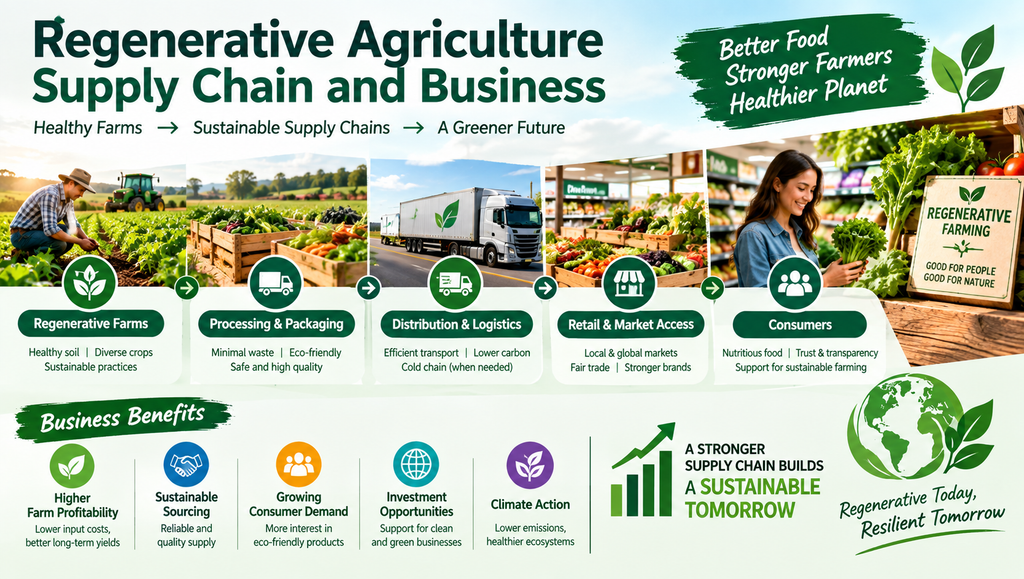
Regenerative farming is increasingly moving beyond individual farms and into the wider food supply chain. Food companies are exploring regenerative supply chains, sustainable sourcing strategies, and climate-positive food production to respond to environmental concerns and consumer expectations. This expansion is strengthening regenerative agriculture trends across the agricultural business sector.
For farmers, the business case is also important. Better soil health can potentially reduce input costs and support long-term productivity. Growing consumer demand for environmentally friendly products may create new markets for regenerative products. In 2026, regenerative agriculture trends are therefore connected with farm profitability, sustainable business models, agribusiness innovation, and sustainable food markets.
Certification, Standards and Market Growth
Certification and verification are becoming increasingly important as regenerative products enter mainstream markets. Regenerative agriculture certification can provide a framework for demonstrating that farms follow specific practices and standards. The development of regenerative agriculture trends is increasing interest in regenerative organic certification, carbon farming certification, and farm verification.
Transparency can also help consumers understand how food is produced. Sustainability standards, supply chain transparency, and sustainable food labeling may strengthen consumer trust. As regenerative agriculture trends continue expanding, certification programs could help distinguish genuine regenerative practices from vague environmental marketing claims.
Market demand is another important factor. Food manufacturers, retailers, investors, and consumers are showing greater interest in sustainable agriculture. The expansion of regenerative agriculture trends could increase regenerative agriculture adoption and create stronger markets for farmers who invest in sustainable production systems.
See more:regenerative agriculture trends
Future Regenerative Agriculture Trends
The future of farming is likely to combine ecological principles with advanced technology. AI-driven regenerative farming could help farmers analyze large amounts of field data, predict crop conditions, and improve resource efficiency. The continued development of regenerative agriculture trends may also accelerate regenerative agritech, agricultural automation, and sustainable AI farming.
Carbon farming growth is expected to remain an important area as businesses and governments explore ways to reduce emissions. Regenerative startups may introduce new tools for soil monitoring, farm management, carbon measurement, and sustainable supply chains. These developments could make regenerative agriculture trends more accessible to farmers who want practical and scalable solutions.
Global adoption will depend on local conditions, farmer education, financing, infrastructure, and market incentives. Not every regenerative practice will work equally well in every region. However, the combination of climate-resilient agriculture, nature-positive farming, and regenerative farming innovation could create more adaptable food systems. The long-term success of regenerative agriculture trends will depend on making these systems both environmentally effective and economically practical.
FAQs
1. What is regenerative agriculture?
Regenerative agriculture is an approach that aims to improve soil health, biodiversity, water management, and ecosystem function while producing food. Modern regenerative agriculture trends focus on restoring natural resources rather than simply maintaining existing conditions.
2. Why are regenerative farming practices important in 2026?
They can help farmers address soil degradation, water scarcity, biodiversity loss, and climate-related risks. Current regenerative agriculture trends are also helping farms explore more efficient and sustainable production methods.
3. How does technology support regenerative farming?
AI, sensors, drones, satellite imagery, robotics, and data analytics can help farmers monitor crops and soil more accurately. These technologies are becoming closely connected with regenerative agriculture trends because they can improve decision-making and resource efficiency.
4. Can regenerative agriculture improve farm profitability?
Potentially, yes. Improved soil health may reduce certain input requirements, support productivity, and improve resilience over time. Some regenerative agriculture trends are also creating new opportunities through sustainable food markets and regenerative supply chains.
5. What is the future of regenerative agriculture?
The future is likely to involve a combination of soil restoration, biodiversity protection, climate-smart practices, precision technology, and sustainable business models. As regenerative agriculture trends continue developing, wider adoption could contribute to more resilient and sustainable food systems.


One Comment