

Organic Farming Methods help farmers produce healthy crops while protecting soil, water, biodiversity, and the wider environment. These approaches reduce dependence on synthetic chemicals and focus on natural processes such as composting, crop rotation, biological pest control, and soil conservation. By improving soil quality and supporting beneficial organisms, farmers can create productive and sustainable farming systems.
Organic Farming Methods also provide practical ways to maintain long-term farm productivity. Techniques such as cover cropping, mulching, intercropping, agroforestry, and conservation farming can improve nutrient cycling, moisture retention, soil structure, and ecosystem balance. When these practices are combined properly, they can support sustainable crop production and better resource management.
Organic Farming Basics
Organic Farming Methods are based on organic agriculture, sustainable agriculture, and natural agricultural practices. Instead of relying heavily on synthetic fertilizers and chemical pesticides, organic farming focuses on eco-friendly farming, chemical-free farming, organic crop production, and ecological farming. Farmers use natural resources and biological processes to maintain productive farm ecosystems.
Organic farming systems aim to build healthy soil and sustainable food production. Natural farming methods can include organic amendments, compost, crop residues, biological pest management, and biodiversity-friendly practices. These techniques help create an environmentally friendly agriculture system while supporting long-term farm productivity.
Soil Health & Fertility
Healthy soil is one of the most important foundations of Organic Farming Methods. Good soil health depends on soil fertility, soil organic matter, soil structure, soil microbes, and microbial activity. Organic farmers improve these conditions by adding compost, manure, plant residues, and other organic soil amendments.
Increasing soil organic matter can improve moisture retention and nutrient cycling. Living soil contains microorganisms that help break down organic materials and release nutrients for crops. Better soil biodiversity can also support soil regeneration and natural soil fertility, helping farmers maintain productive land over many growing seasons.
Crop Rotation & Crop Management
Crop rotation is another important part of Organic Farming Methods because growing different crops in sequence can improve soil and reduce agricultural problems. Seasonal crop rotation allows farmers to diversify their fields instead of repeatedly planting the same crop in one location.
Crop diversification can support nutrient management, disease prevention, and pest life cycle disruption. Different crops have different nutrient requirements and root structures, which can improve soil conditions over time. Rotational cropping can therefore contribute to sustainable crop production, crop health, and agricultural productivity.
See more:Organic Farming Methods
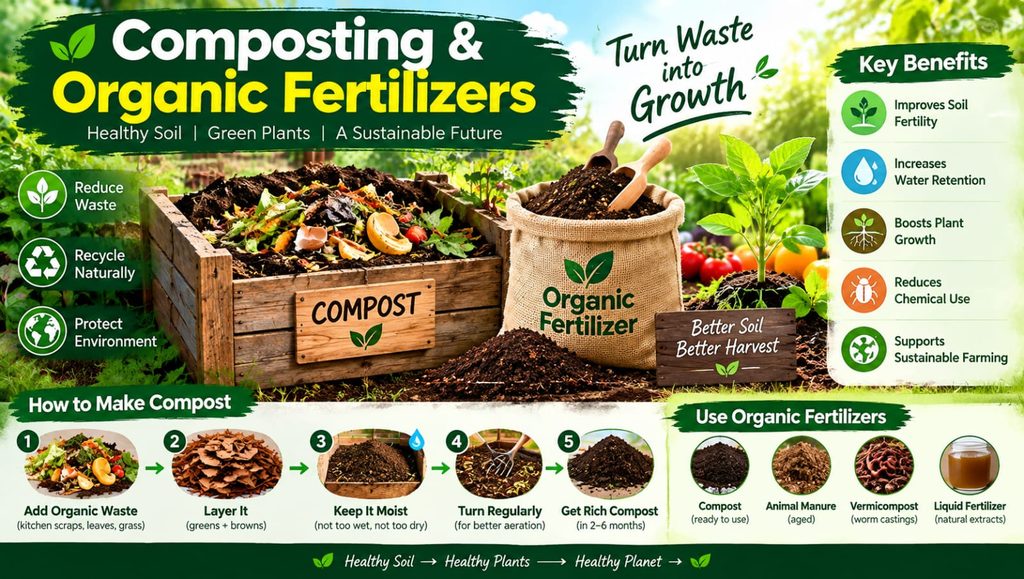
Composting & Organic Fertilizers
Composting is a valuable component of Organic Farming Methods because it converts organic waste into nutrient-rich material that can improve soil fertility. Farmers can produce compost from crop residues, animal manure, leaves, food waste, and other biodegradable materials.
Organic fertilizers such as compost manure, farmyard manure, and green manure provide plant nutrients while adding organic matter to the soil. Natural fertilizers can improve soil structure and support microbial activity. Regular application of nutrient-rich compost can also contribute to natural nutrient management and long-term soil enrichment.
Cover Crops & Green Manure
Cover crops are widely used in Organic Farming Methods to protect soil between major crop cycles. Farmers may plant legumes, grasses, or other suitable species to cover exposed soil and reduce erosion. Cover crop management can also provide biomass that later becomes organic matter when incorporated into the soil.
Green manure is particularly useful because some legume cover crops can contribute to nitrogen fixation. These plants can improve soil structure, support beneficial soil organisms, and recycle nutrients. Cover crops also help with moisture conservation, erosion control, and organic matter addition.
Natural Pest & Weed Management
Natural pest control is an essential part of Organic Farming Methods because organic production aims to reduce dependence on synthetic pesticides. Biological pest control uses beneficial insects, natural predators, and other organisms to help manage harmful pest populations.
Organic pest management can also include resistant crop varieties, habitat management, cultural pest management, and pest lifecycle management. Farmers can use mechanical weed control, mulching, crop rotation, and timely cultivation for weed management. Integrated pest management combines several techniques to prevent pest problems before they become severe.
Mulching & Soil Protection
Organic mulching is another practical technique among Organic Farming Methods. Farmers can cover the soil with crop residues, straw, leaves, grass, or other suitable mulch materials. This protective layer reduces direct exposure of soil to sunlight, wind, and heavy rainfall.
Mulch can help with soil moisture conservation, weed suppression, and soil temperature regulation. As organic mulch decomposes, it can also add organic matter and contribute to nutrient recycling. Sustainable mulching therefore provides both immediate soil protection and longer-term benefits for soil fertility.
Agroforestry & Biodiversity
Agroforestry combines trees and crops within a diversified farming system and is an important example of Organic Farming Methods. Trees can provide shade, organic material, habitat, and protection against wind and erosion. Tree-based farming can also improve farm ecosystems when species are selected according to local conditions.
Biodiversity supports ecosystem balance by providing habitats for beneficial insects, birds, microorganisms, and other organisms. Agroecological farming systems with greater biodiversity can improve habitat creation and support natural ecosystems. These practices can contribute to climate-resilient farming and sustainable land management.
Intercropping & Polyculture
Intercropping involves growing two or more crops together, while polyculture uses multiple crop species within the same farming system. Both are useful Organic Farming Methods because they increase crop diversity and make better use of available land.
Mixed cropping and companion planting can encourage beneficial plant interactions and resource sharing. Diverse crops may also help reduce pest pressure and enhance biodiversity. Multiple crop systems can improve efficient land use while providing farmers with diversified agricultural production rather than depending on a single crop.
See more:Organic Farming Methods
No-Till & Conservation Farming
No-till farming reduces the amount of soil disturbance caused by traditional cultivation and is increasingly considered among useful Organic Farming Methods. Organic no-till and minimum tillage approaches help maintain soil structure while reducing unnecessary disturbance of soil organisms.
Conservation agriculture can support soil erosion control, moisture conservation, and soil biodiversity. Reduced soil disturbance may also help organic matter accumulation and soil carbon storage. When combined with cover crops and crop rotation, conservation farming can contribute to sustainable soil management and carbon sequestration.
Livestock & Integrated Farming
Integrated livestock farming connects crop production with livestock activities and can strengthen Organic Farming Methods at the farm level. Animal manure can be recycled as an organic fertilizer, while crop residues may provide useful feed or bedding materials depending on the farming system.
Organic livestock management emphasizes animal welfare, suitable organic animal feed, pasture management, and natural livestock production. Crop-livestock systems can improve nutrient recycling and farm biodiversity. Rotational grazing can also support pasture health when animals are managed according to land capacity.

Water & Climate Sustainability
Water conservation is essential for successful Organic Farming Methods, especially in areas affected by drought or irregular rainfall. Farmers can improve water retention through organic matter, mulching, cover crops, improved soil structure, and suitable irrigation practices.
Sustainable water management can improve drought resilience while reducing water waste. Climate-smart agriculture and climate-resilient farming approaches also help farmers adapt to changing environmental conditions. Erosion reduction and water pollution prevention are additional benefits of responsible natural resource management.
Organic Certification & Standards
Organic certification provides a formal framework for Organic Farming Methods used in commercial production. Organic certification generally involves meeting defined organic standards, maintaining records, following certification requirements, and passing farm inspections.
Organic labeling helps consumers identify certified organic products. Farmers seeking certification may need an organic system plan and must follow the rules established by the relevant certification body. Annual certification and compliance requirements help maintain consistency and transparency in organic production.
Sustainability & Environmental Benefits
Environmental sustainability is a major goal of Organic Farming Methods. Reducing chemical use can help protect soil organisms, water resources, and surrounding ecosystems. Organic practices can also support biodiversity conservation and natural resource conservation.
Soil conservation, water conservation, and sustainable land use contribute to long-term farm sustainability. Organic matter management and conservation practices may also support carbon sequestration. By using renewable resources and encouraging ecosystem health, organic farming can create a more environmentally responsible agricultural system.
Organic Farming Benefits
The benefits of Organic Farming Methods extend beyond individual crops because they can improve soil, biodiversity, water management, and overall farm resilience. Improved soil fertility and better soil structure create favorable conditions for healthy crops and productive root systems.
Natural pest management and biodiversity improvement can reduce reliance on synthetic chemical inputs. Other potential benefits include reduced chemical exposure, sustainable yields, water conservation, healthier ecosystems, and improved soil microbial activity. When organic practices are managed effectively, they can contribute to long-term productivity and sustainable food production.
Conclusion
Organic Farming Methods provide farmers with a practical approach to improving crop production while protecting natural resources. Techniques such as crop rotation, composting, cover crops, natural pest management, mulching, intercropping, agroforestry, and conservation farming work together to improve soil health and farm biodiversity.
The most effective results usually come from combining several practices rather than relying on one technique alone. By focusing on soil fertility, efficient water use, biodiversity, natural nutrient cycling, and responsible pest management, farmers can build productive and environmentally sustainable agricultural systems for the future
What are organic farming methods?
Organic farming methods are natural farming practices that focus on healthy soil, natural fertilizers, biological pest control, crop diversity, and reduced use of synthetic chemicals.
Which organic farming method is best for soil health?
Composting, crop rotation, cover crops, green manure, and mulching are highly useful for improving soil fertility, organic matter, structure, and microbial activity.
How does organic farming improve crop production?
Organic farming can improve crop production by maintaining soil fertility, improving moisture retention, supporting beneficial organisms, and reducing certain pest and disease pressures.
Is crop rotation an organic farming method?
Yes. Crop rotation is an important organic farming practice that can improve nutrient management, reduce disease problems, and disrupt pest life cycles.
What are the main benefits of organic farming?
Major benefits include healthier soil, improved biodiversity, reduced chemical use, better water conservation, environmental protection, and long-term farm sustainability.


One Comment