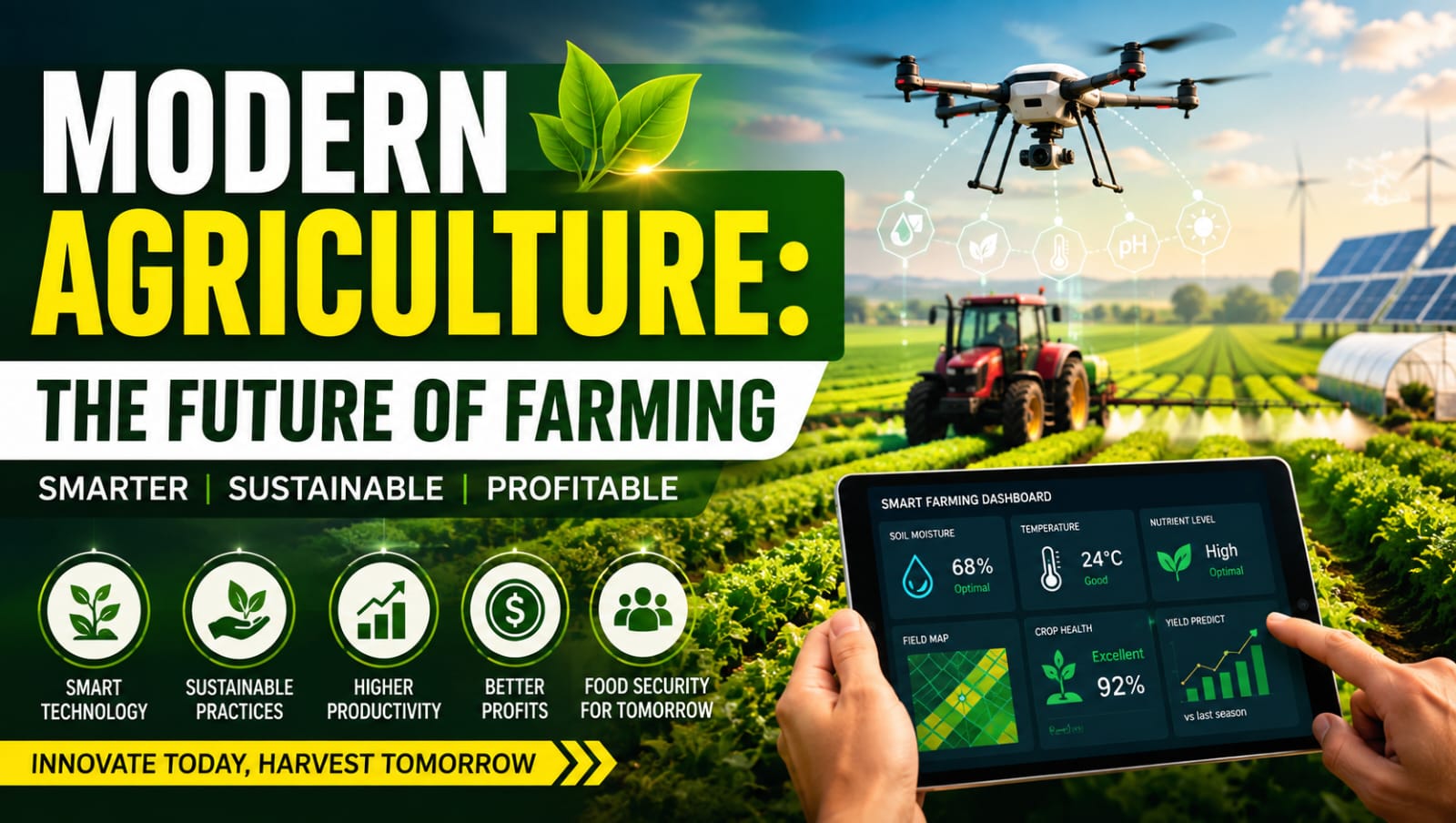
Modren Agriculture:The Future of Farming is changing the way farmers grow crops and manage farms by combining traditional farming methods with advanced technology. Precision agriculture, smart farming, drones, sensors, artificial intelligence, automation, and data-driven farming help farmers improve crop yields, save water, reduce fertilizer waste, and manage resources more efficiently.
The future of farming focuses on productivity, sustainability, and food security. Modern farming practices such as efficient irrigation, soil conservation, climate-smart agriculture, and integrated pest management can help farmers deal with climate change, rising production costs, and growing food demand. By adopting innovative technologies and sustainable practices, agriculture can become more productive, profitable, and environmentally friendly.
Modern Agriculture and Smart Farming
Modern agriculture is transforming traditional farming through technology, data, and sustainable practices. Also known as smart agriculture or smart farming, it uses agriculture technology such as sensors, GPS, drones, automation, artificial intelligence, and data analysis to help farmers make better decisions. These tools support digital agriculture and intelligent farming by monitoring crops, soil conditions, irrigation, weather, and farm operations in real time.
The development of Agriculture 4.0 represents the next stage of modern farming, where technology-driven solutions and agricultural innovation are becoming central to food production. Advanced farming techniques, innovative agriculture, and other modern agricultural practices can improve productivity, reduce resource waste, and increase farm efficiency. As global food demand rises, these technologies are shaping the future of farming by making agriculture more productive, sustainable, and resilient.
Precision Agriculture and Data-Driven Farming
Precision agriculture and precision farming use technology and real-time information to make farming more accurate and efficient. Through site-specific farming, farmers can understand differences in soil, moisture, nutrients, and crop conditions across individual fields. Farm management technology, agricultural data analytics, and field mapping help farmers collect and analyze useful information, allowing better decisions about planting, irrigation, fertilization, and crop protection.
Variable rate technology enables farmers to apply targeted inputs according to the specific needs of different areas. Precision crop management, precision irrigation, and precision fertilization can reduce unnecessary use of water and fertilizers while improving crop health. By combining data-driven farming with these advanced practices, farmers can improve farm productivity, reduce input costs, and achieve better yield optimization.
Internet of Things and Smart Sensors
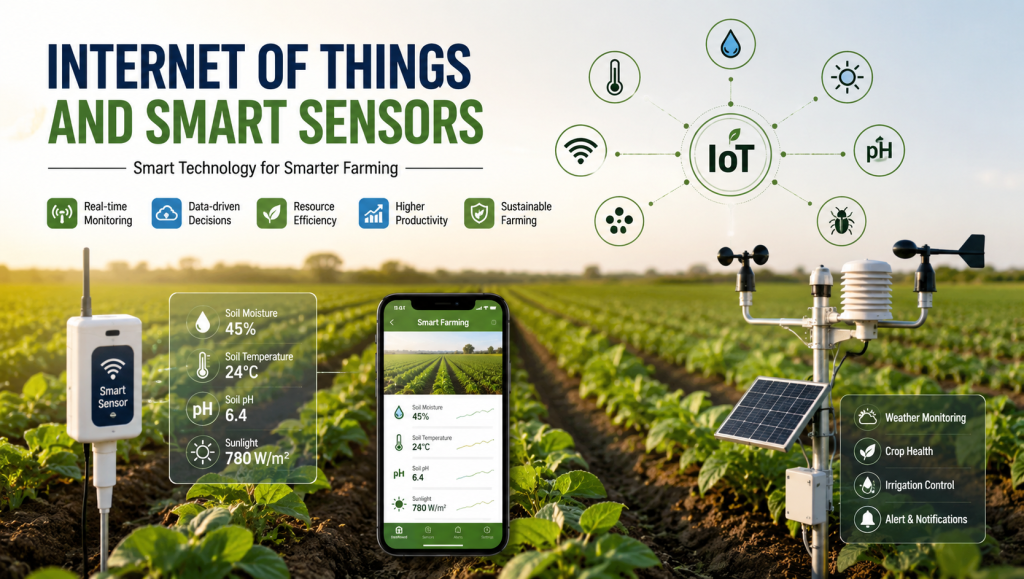
The Internet of Things in agriculture, also called IoT agriculture or agricultural IoT, is making farms more connected and efficient. Smart farming sensors, including IoT sensors, soil moisture sensors, soil temperature sensors, soil nutrient sensors, weather sensors, and environmental sensors, collect important field data. These wireless sensors work through sensor networks to provide real-time monitoring and help farmers understand soil, weather, and crop conditions more accurately.
Through remote monitoring, farmers can manage connected farm devices and smart agricultural equipment from different locations. Technologies such as LoRaWAN agriculture provide reliable wireless communication between sensors and farm systems, supporting sensor-based farming and automated monitoring. This allows farmers to respond quickly to changing field conditions, improve resource management, and make smarter decisions for healthier crops and better farm productivity.
Artificial Intelligence and Machine Learning
Artificial intelligence in agriculture is transforming farming by helping farmers analyze large amounts of data and make faster, more accurate decisions. AI farming and AI-powered agriculture use machine learning in agriculture, deep learning, and agricultural AI to identify patterns in soil, weather, crops, and field conditions. Through predictive analytics, farmers can improve intelligent decision-making, crop prediction, and yield forecasting, helping them plan farming activities more efficiently.
Advanced systems can also support disease detection, pest detection, and AI crop monitoring through computer vision and automated diagnosis. By using agricultural algorithms, data analysis, and predictive farming, AI can provide smart decision support for irrigation, crop protection, and resource management. These technologies can help farmers reduce losses, improve productivity, and make agriculture more efficient and sustainable.
Drones, Robotics and Automation
Agricultural drones, also known as farming drones, are becoming valuable tools in UAV agriculture. They support drone crop monitoring, aerial imaging, and remote sensing, allowing farmers to inspect large fields, identify crop stress, and monitor plant health quickly. Drone-based farming can also support precision spraying, helping farmers apply crop protection products more accurately and reduce unnecessary input use.
At the same time, agricultural robotics, farm robots, and autonomous farming are improving farm operations. Robots can perform tasks such as robotic harvesting and robotic weeding, while automated machinery, autonomous agricultural equipment, and smart machinery reduce manual labor. Automated irrigation, unmanned vehicles, machine automation, and agricultural automation are further helping farmers increase efficiency, save resources, and create a more productive and technology-driven farming system.
see more:Modren Agriculture:The Future of Farming
Soil and Crop Monitoring
Soil monitoring is an important part of modern farming because healthy soil directly affects crop performance. Soil health monitoring, soil moisture monitoring, and soil nutrient monitoring help farmers understand water availability, nutrient levels, and overall soil conditions. Through soil analysis, soil fertility management, nutrient management, and soil condition assessment, farmers can apply the right resources at the right time and maintain productive fields.
Crop monitoring and crop health monitoring provide valuable information about plant development throughout the growing season. Agricultural sensors can support plant health detection, crop growth tracking, field monitoring, and collection of real-time crop data. In addition, environmental monitoring, temperature monitoring, and humidity monitoring help identify changing conditions, while crop stress detection and plant disease monitoring allow farmers to respond quickly and protect crop health and yield.
Smart Irrigation and Water Management
Smart irrigation is helping farmers improve water management by delivering the right amount of water according to crop needs. Precision irrigation, irrigation management, and irrigation sensors use soil moisture detection and real-time field information to determine crop water requirements. Automated irrigation and automated watering systems can then adjust water application, reducing waste and supporting efficient water use.
Modern drip irrigation technology, smart water systems, and real-time irrigation control are important tools for water conservation and water-saving agriculture. Proper irrigation scheduling helps farmers achieve better water optimization, while improved agricultural water efficiency supports drought management in areas facing limited water availability. Together, these technologies make irrigation more precise, sustainable, and cost-effective.
Agricultural Resource Optimization
Resource optimization is an important part of modern agriculture because farmers need to produce more while using fewer resources. Input optimization improves fertilizer efficiency, water efficiency, and energy efficiency by ensuring that farm inputs are used according to actual crop requirements. Proper input management, optimized fertilizer application, and targeted pesticide application can support pesticide reduction, reduced chemical use, and reduced resource wastage.
Efficient farming also focuses on efficient resource management, agricultural waste reduction, and energy-saving farming. Using sustainable inputs and modern technologies can contribute to farm cost reduction, productivity improvement, and better operational efficiency. When resources are managed carefully, farmers can improve crop production while reducing unnecessary expenses and increasing overall farm profitability.
Smart Greenhouses and Controlled Farming
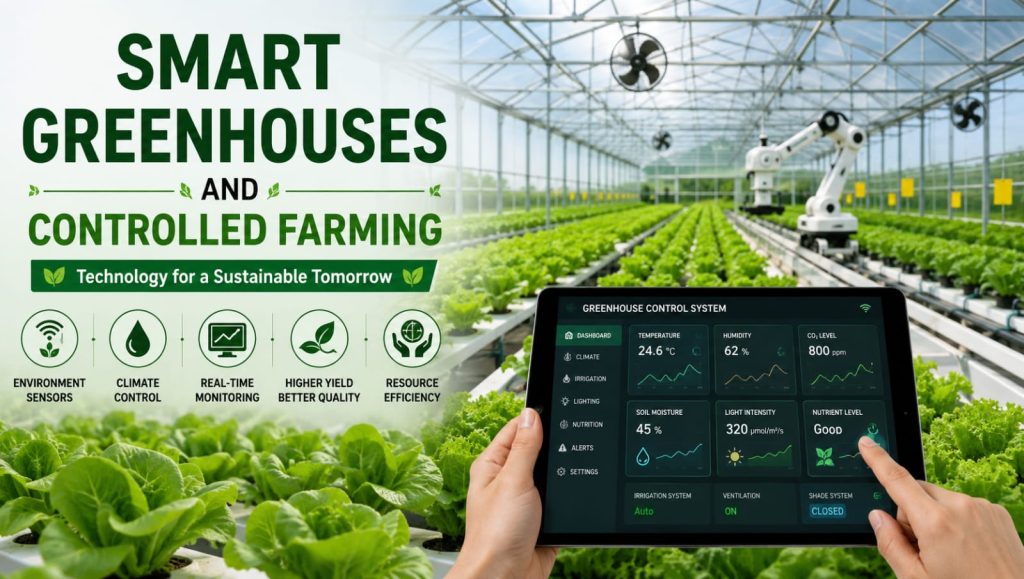
A smart greenhouse uses advanced greenhouse technology to create an ideal growing environment for crops. Controlled environment agriculture and controlled farming allow farmers to manage temperature, humidity, light, and ventilation with greater accuracy. Through greenhouse automation, automated climate control, and greenhouse sensors, farmers can maintain precise temperature control and humidity control. Smart ventilation and crop environment monitoring further support healthy plant growth and efficient resource use.
Beyond greenhouses, indoor farming, vertical farming, hydroponic farming, and aeroponics are expanding the possibilities of soilless agriculture and protected cultivation. These methods can support year-round crop production even where land or suitable outdoor conditions are limited. Urban farming and controlled crop production are also helping bring fresh food closer to consumers while improving control over growing conditions and resource management.
Crop Protection and Disease Management
Modern farming uses smart pest management and integrated pest management to protect crops while reducing unnecessary chemical use. Regular pest monitoring, pest detection, and disease detection help farmers identify potential problems before they spread. Technologies for crop disease monitoring, early disease detection, and AI disease diagnosis can support faster responses, while precision pest control and smart crop protection allow treatments to be applied where they are actually needed.
Biological pest control, targeted spraying, and pesticide optimization are important parts of modern crop protection technology. Tools for plant disease identification, pest prediction, and crop health assessment can provide valuable information about field conditions. Combined with early warning systems and agricultural risk management, these approaches help farmers prevent crop losses, improve plant health, and build more sustainable crop protection strategies.
see more:Modren Agriculture:The Future of Farming
Farm Machinery and Agricultural Equipment
Modern farm machinery is making agricultural work faster, more accurate, and less labor-intensive. Agricultural machinery, including smart tractors, autonomous tractors, precision equipment, and other farm equipment, helps farmers perform planting, harvesting, tillage, and field preparation efficiently. GPS-guided machinery, precision planting equipment, and precision harvesting technologies improve accuracy, while automated farm machinery and automated harvesting reduce manual effort and save valuable time.
The development of intelligent machinery, smart agricultural tools, and agricultural equipment technology is supporting mechanized farming and greater machinery efficiency. Farm automation systems, connected machinery, and digital farm equipment allow machines to share information and work more effectively. With advanced agricultural machinery, farmers can improve productivity, reduce operating costs, and manage large-scale farming operations more efficiently.
Post-Harvest Technology and Grain Management
Post-harvest technology plays an important role in reducing losses and maintaining crop quality after harvesting. Agricultural drying technology, including grain drying and crop drying, helps remove excess moisture before storage. Modern drying systems and agricultural dryers can provide better moisture control and maintain the required safe storage moisture. Energy-efficient drying and heat recovery technologies can also reduce energy consumption while protecting grain quality and seed quality.
Effective grain storage, smart grain storage, and storage management are essential parts of post-harvest management. Proper handling supports crop quality preservation and food quality preservation while reducing post-harvest losses. Modern agricultural processing methods further improve the handling, cleaning, drying, and storage of harvested crops, helping farmers and food producers maintain quality from harvest to market.
What is modern agriculture?
Modern agriculture uses advanced technology, data, machinery, and sustainable farming practices to improve crop production, reduce resource waste, and increase farm efficiency.
How is technology changing the future of farming?
Technologies such as artificial intelligence, drones, IoT sensors, precision agriculture, robotics, and automated machinery help farmers monitor crops, manage resources, and make better farming decisions.
What is precision agriculture?
Precision agriculture is a technology-based farming approach that uses field data, GPS, sensors, and variable-rate technology to apply water, fertilizers, and other inputs according to specific crop and soil requirements.
How does smart farming help farmers?
Smart farming provides real-time information about soil, weather, crops, and farm operations. This helps farmers improve productivity, reduce input costs, conserve water, and respond quickly to crop problems.
Why is modern agriculture important for sustainable farming?
Modern agriculture can support sustainable farming by improving water and fertilizer efficiency, reducing chemical and resource waste, protecting soil health, and increasing food production with fewer resources.