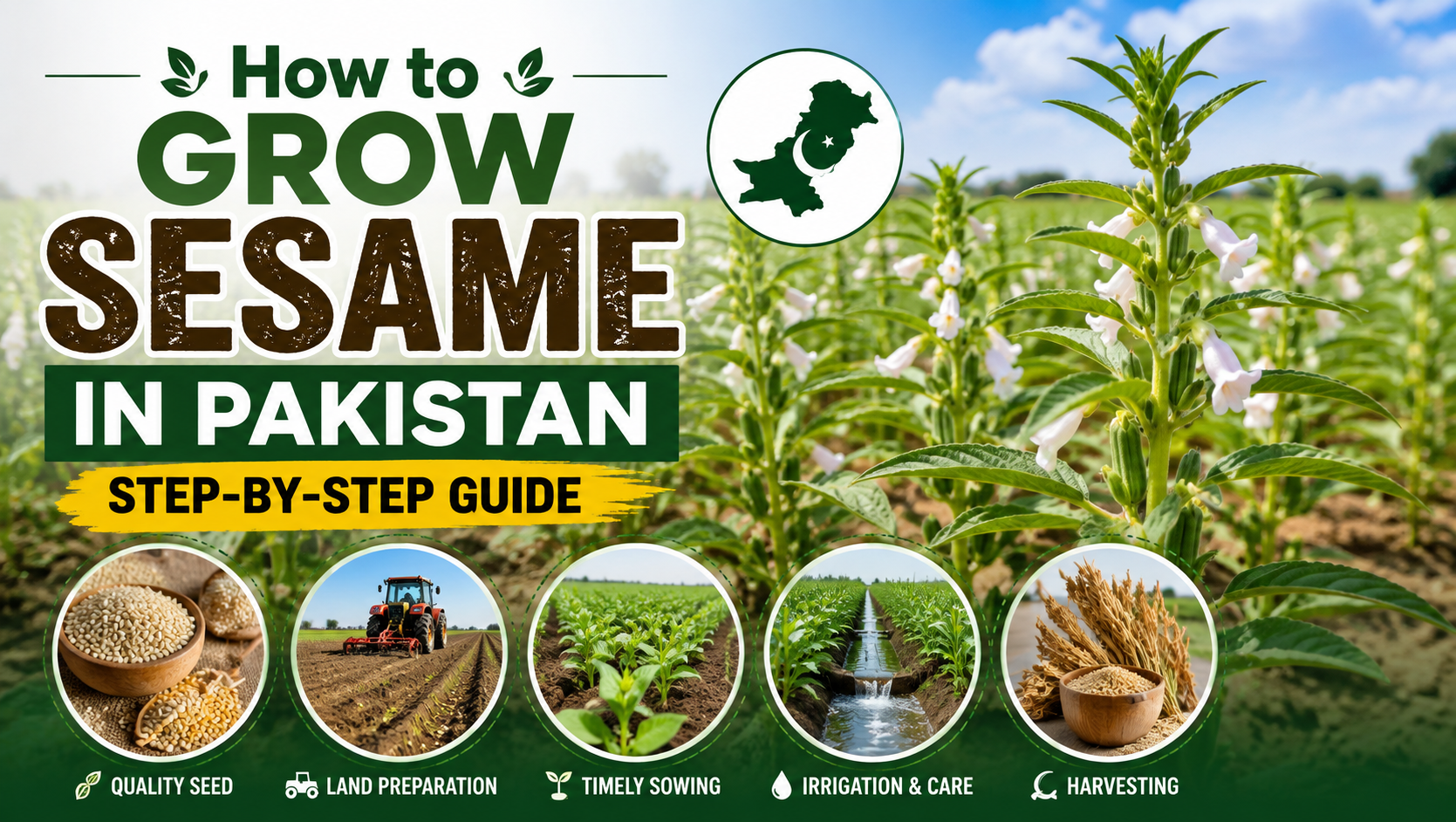
How to Grow Sesame in Pakistan is becoming increasingly important because of the crop’s short duration, relatively low input requirements, and growing market demand. Also known as til, sesame is an important oilseed crop cultivated mainly during the warm Kharif season. Sesame cultivation in Pakistan is especially significant in Punjab, while suitable areas of Sindh, Khyber Pakhtunkhwa, and Balochistan also support production.
The growing demand for How to Grow Sesame in Pakistan has created attractive opportunities for farmers. Til cultivation and til farming in Pakistan can provide valuable returns when farmers use suitable varieties, proper sowing methods, and effective crop management.
Table of Contents
Climate and Weather Requirements
Sesame performs best under warm weather and is well suited to a hot climate with plenty of sunlight. The ideal sesame growing conditions generally include temperatures around 20–30°C, while very low temperatures can slow growth. Sesame is commonly grown as a Kharif season crop and summer crop in Pakistan, making the warm months suitable for its development.
A suitable climate for sesame is generally warm and relatively dry climate, with good drainage and no prolonged waterlogging. Sesame is considered a drought tolerant crop, but adequate moisture is important during germination and early growth. For rainfall requirements, sesame generally performs well with moderate seasonal rainfall, while excessive rain and prolonged monsoon conditions can cause waterlogging and negatively affect the crop.
Best Areas for Sesame Cultivation in Pakistan
Pakistan has several sesame growing areas, with Punjab being the main production region. Official agriculture sources identify important sesame producing areas across Punjab, Sindh, Khyber Pakhtunkhwa, and Balochistan. Punjab remains the leading province, accounting for the vast majority of national sesame production.
| Area / Region | How to Grow Sesame in Pakistan |
|---|---|
| Punjab | The leading province for sesame, with major production concentrated in several districts. |
| Southern Punjab | Southern Punjab sesame production is particularly important, including Multan sesame farming and Bahawalpur sesame farming areas. |
| Central Punjab | Important Punjab sesame cultivation areas include Faisalabad sesame production, Gujranwala sesame cultivation, and surrounding districts. |
| Bhakkar | Bhakkar sesame cultivation is an important part of sesame production in the Sargodha region and has recorded substantial cultivated area. |
| Sialkot & Gujranwala | Sialkot sesame farming and Gujranwala sesame cultivation are among the potential areas identified by Punjab Agriculture Department. |
| Sindh | Sindh sesame cultivation is practiced particularly in areas such as Dadu, Hyderabad, and Tharparkar. |
| Khyber Pakhtunkhwa | Khyber Pakhtunkhwa sesame cultivation has potential around Kohat and Dera Ismail Khan sesame farming areas. |
| Balochistan | Balochistan sesame cultivation has potential in areas including Naseerabad and Lasbela, supported by suitable climatic conditions. |
For farmers choosing a location, well-drained land, suitable temperatures, and appropriate water availability are more important than simply being within a recognized sesame-producing district. Current Punjab estimates also show significant sesame cultivation in areas such as Bhakkar, Faisalabad, Multan, and Bahawalpur.
Also Read this: How to Grow Sesame in Pakistan
Soil Requirements and Land Selection
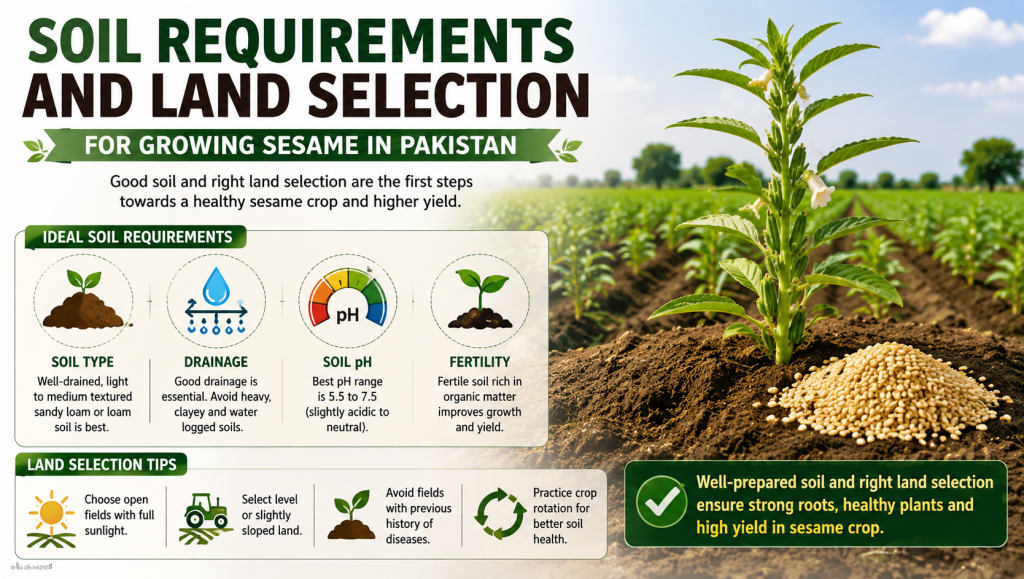
Selecting suitable land is an important step when learning how to grow sesame in Pakistan. The best soil for sesame is generally fertile, medium-textured, and well drained soil, with sandy loam soil and loamy soil being good choices. Sesame prefers adequate soil moisture during establishment but does not tolerate prolonged waterlogging. FAO data indicates that sesame performs well in well-drained soils with a suitable soil pH of about 5.5–7.5.
Important Soil Requirements
- Best soil for sesame: Sandy loam and loamy soils with good structure are preferred.
- Sesame soil requirements: The field should have good fertility, sufficient moisture, and effective drainage.
- Soil fertility: Moderately fertile soil supports healthy plant growth and seed development.
- Soil drainage: Choose land where excess rainwater or irrigation water can drain quickly.
- Soil pH for sesame: A pH around 5.5–7.5 is generally suitable.
- Suitable soil pH: Near-neutral soil is particularly favorable for sesame growth.
- Alkaline soil: Highly alkaline fields should be tested before planting because high pH can affect nutrient availability.
- Calcareous soil: Calcareous fields can be used where other soil properties are suitable, but a soil test helps identify nutrient limitations.
- Saline soil: Avoid highly saline fields; sesame has better performance under low-salinity conditions.
- Sodic soil: Highly sodic land should be avoided or properly reclaimed before sesame cultivation because poor soil structure and infiltration can restrict crop growth.
- Soil moisture: Maintain adequate moisture during germination and early establishment, while avoiding standing water.
Before sowing, farmers should preferably conduct a soil test to determine pH, salinity, sodicity, organic matter, and nutrient status. Most importantly, avoid low-lying fields that regularly retain water because sesame is sensitive to waterlogging.
Land Preparation and Seedbed Preparation
Proper sesame land preparation is essential how to grow sesame in pakistan because sesame seeds are very small and need a fine seedbed with adequate moisture for uniform germination. In Pakistan, the recommended preparation generally involves 2–3 ploughing followed by planking to break clods and create fine tilth. Field leveling is also important because sesame is sensitive to standing water.
Steps for Preparing the Land
- Remove weeds and residues: Start with a clean, weed free field by removing existing weeds and unwanted crop residues.
- Plough the field: Carry out 2–3 rounds of ploughing to loosen the soil and break compact layers.
- Use a rotavator if needed: A rotavator can be used to break soil clods and produce a finer seedbed.
- Consider deep tillage: Where a hardpan exists, deep tillage with a chisel plough can improve soil structure and drainage.
- Harrow the soil: Perform harrowing after ploughing to break remaining clods and create a smooth planting surface.
- Plank the field: Use planking to level the soil and prepare a firm, fine seedbed.
- Complete field leveling: Proper field leveling helps distribute irrigation water evenly and reduces the risk of waterlogging.
- Maintain suitable moisture: Prepare the final seedbed when the soil has suitable moisture—it should be moist enough for germination but not excessively wet.
The final sesame seedbed preparation should leave the field fine, level, firm, and weed free, providing favorable conditions for quick and uniform seed emergence.
Sesame Varieties and Certified Seed
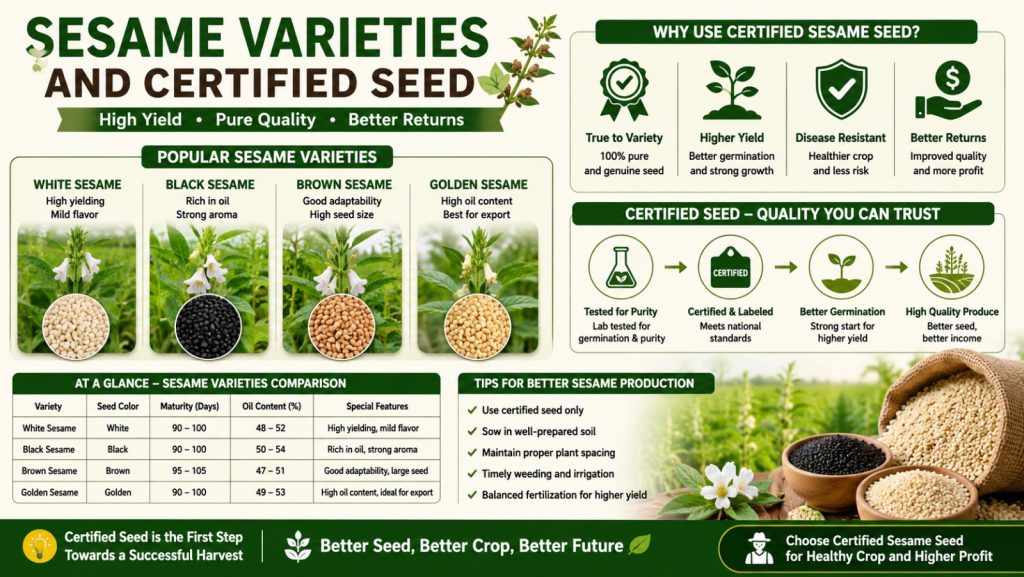
Choosing the right sesame varieties Pakistan farmers can grow is important for achieving good yield and better crop performance. The Punjab Agriculture Department recommends several best sesame varieties, including TH-6 sesame, TS-5 sesame, TIL-18, TS-3 sesame, NIAB Pearl, NIAB Til-2016, and newer varieties such as Anmol Til and Black King. These include both branched sesame varieties and single stem sesame varieties, with some offering better heat or disease tolerance.
Recommended Sesame Varieties and Their Features
| Variety | Main Features |
|---|---|
| TH-6 sesame | High yielding, single-stem type, relatively heat tolerant and popular for its performance under high temperatures. |
| TS-5 sesame | High yielding, branched variety with good disease tolerance. |
| TIL-18 | High yielding, branched variety with clustered capsules and tolerance to lodging and diseases. |
| TS-3 sesame | High yielding, branched, short-to-medium stature and comparatively tolerant to waterlogging, insects and diseases. |
| NIAB Pearl | Branched variety with good disease tolerance and strong stem, helping reduce lodging and how to grow sesame in pakistan |
| NIAB Til-2016 | Branched variety with disease tolerance, lodging resistance and bold, shining-white seeds. |
| Punjab Til-89 | Older branched variety with good yield potential and disease tolerance. |
Guideful Steps for Selecting Seed
- Choose an approved variety: Select a variety recommended for your district and local growing conditions rather than using an unknown local seed.
- Buy certified sesame seed: Prefer certified sesame seed from an authorized seed supplier or reputable source. Official seed-tag records show certified and approved seed availability for several major sesame varieties.
- Check seed quality: Use clean, pure and quality sesame seed that is free from damaged seeds, impurities and visible disease.
- Look for high germination: Select high germination seed so plants establish evenly and maintain a suitable crop population.
- Match variety to conditions: In hotter areas, consider varieties with better heat tolerance, while disease tolerant varieties can be useful how to grow sesame in pakistan where disease pressure is common..
Read this if you are interested: Trade Development Authority of Pakistan (TDAP)
Sesame Diseases and Disease Control
Common sesame diseases and sesame crop diseases include charcoal rot, phyllody disease, bacterial blight, wilt disease, and root rot. These fungal diseases and bacterial diseases can cause wilting, leaf damage, root decay, and poor seed development.
For effective disease management and disease prevention, use healthy seed, maintain proper drainage, remove infected plants, control weeds, and practice crop rotation. Regularly checking for early disease symptoms helps farmers take timely action and protect the sesame crop.
Best Practices for How to Grow Sesame in Pakistan
For successful sesame farming, use certified seed, timely sowing, proper spacing, balanced fertilizer, efficient irrigation, and regular weed control. Modern sesame cultivation and precision agriculture can support how to grow sesame in pakistan production and high yields.
Regular pest control and disease management, followed by timely harvesting and proper post harvest handling, help maintain seed quality. These practices also promote scientific sesame farming and sustainable sesame farming.
What is the best climate for growing sesame in Pakistan?
Sesame grows best in hot, warm, and relatively dry weather with adequate sunlight. It is mainly cultivated as a Kharif season crop in Pakistan.
Which soil is best for sesame cultivation in Pakistan?
The best soil for sesame is fertile, well-drained sandy loam or loamy soil with suitable soil moisture and a pH of around 5.5–7.5.
Which sesame varieties are best for farmers in Pakistan?
Popular varieties include TH-6, TS-5, TIL-18, TS-3, NIAB Pearl, NIAB Til-2016, and Punjab Til-89. Farmers should select varieties recommended for their local conditions.
How can farmers control sesame pests and diseases?
Regular crop scouting, weed control, certified seed, proper drainage, crop rotation, pest monitoring, and integrated pest management (IPM) can help reduce sesame pests and diseases.
What are the best practices for how to grow sesame in pakistan?
Use certified seed, timely sowing, proper spacing, balanced fertilizer, efficient irrigation, weed control, pest and disease management, timely harvesting, and proper post-harvest handling for better sesame production.