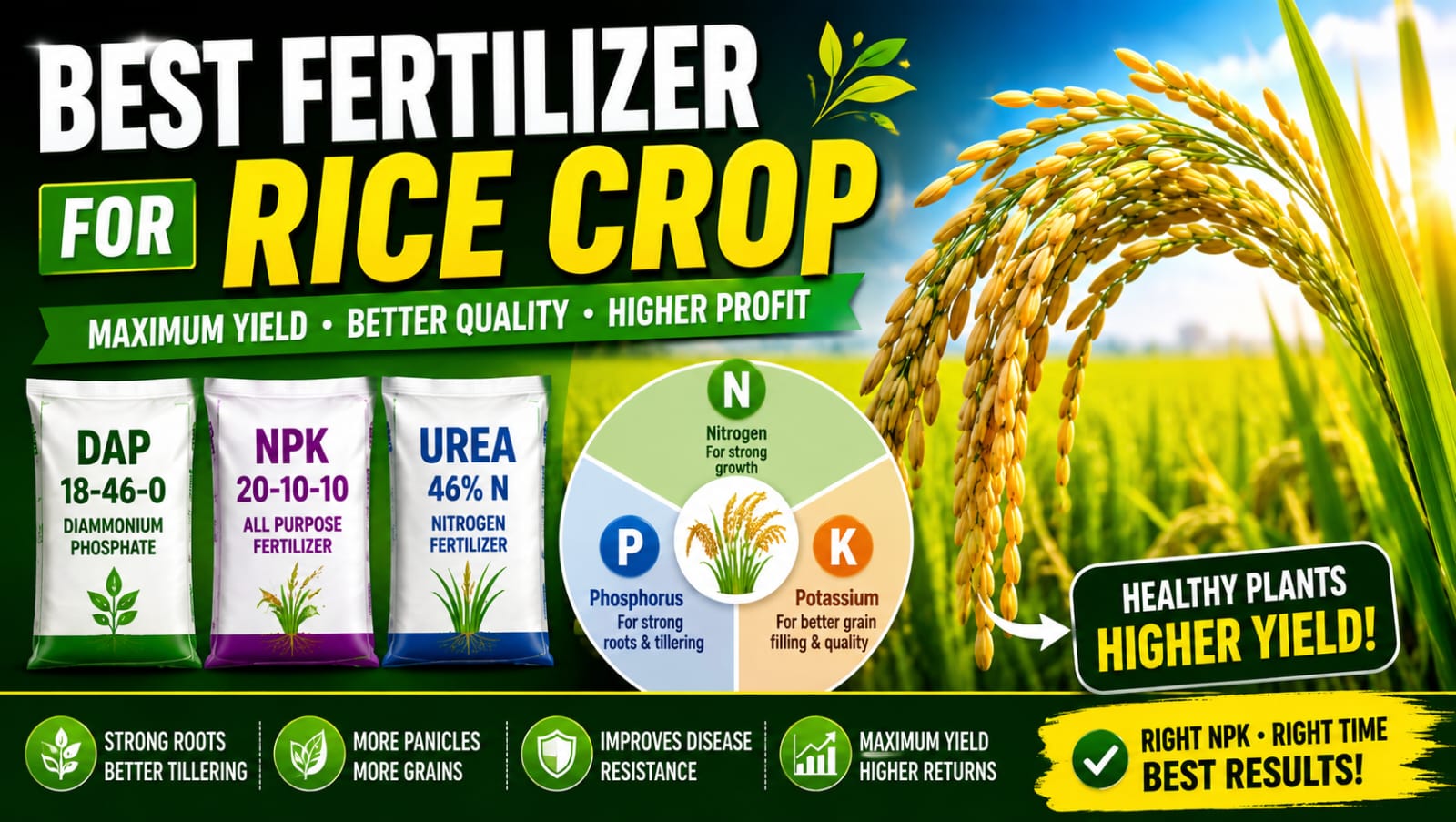
Choosing the best fertilizer for rice crop is important for healthy growth, strong tillering, proper grain formation, and higher yield. Rice mainly requires nitrogen (N), phosphorus (P), and potassium (K), while nutrients such as zinc may also be needed when the soil has a deficiency. Common fertilizers include urea, DAP, MOP, zinc sulfate, organic manure, and compost.
A balanced NPK fertilizer program should be based on soil condition, rice variety, and crop growth stage. Nitrogen supports leaf and tiller development, phosphorus encourages strong roots and early growth, while potassium improves plant strength and grain development. Applying the right fertilizer at the right time helps improve nutrient uptake, crop growth, and rice yield.
Rice Fertilizer Basics
The best fertilizer for rice crop provides a balanced supply of essential nutrients, mainly nitrogen (N), phosphorus (P), and potassium (K). These nutrients are the foundation of rice plant nutrition and play different roles in growth, tillering, root development, grain formation, and rice yield improvement. A proper rice fertilizer or paddy fertilizer program should therefore focus on the crop’s nutrient requirements rather than applying fertilizer in excess.
Good rice nutrient management means selecting the right fertilizer for rice, applying it at the appropriate growth stage, and maintaining a proper crop nutrient balance. Nitrogen is particularly important for tillering and yield, while phosphorus supports root development and early growth, and potassium improves plant vigor and helps reduce lodging. Effective rice fertilization improves nutrient uptake and fertilizer efficiency, making fertilizer management an important part of modern rice farming, paddy crop nutrition, and high-yield rice production.
NPK Nutrients for Rice
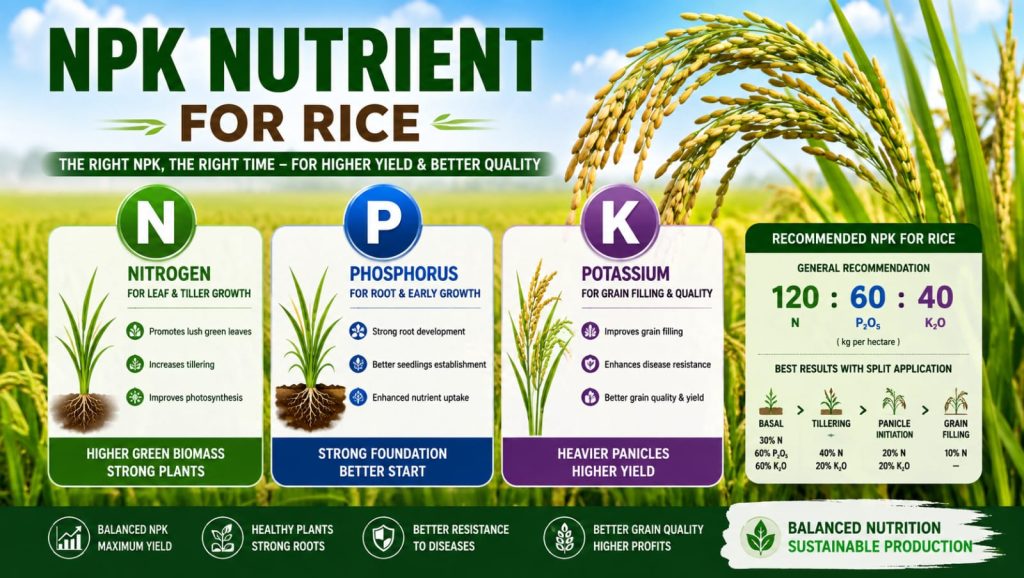
Rice mainly depends on three primary macronutrients: nitrogen, phosphorus, and potassium. These NPK nutrients are essential for healthy growth, tillering, root development, grain formation, and better yield. Nitrogen for rice supports leaf growth and tillering, phosphorus for rice promotes root development and early growth, while potassium for rice improves plant vigor and helps reduce lodging.
The right NPK fertilizer for rice and NPK ratio for rice depends on soil fertility, variety, yield target, and local conditions. A balanced supply of nitrogen phosphorus potassium improves nutrient availability and nutrient uptake by rice, while an imbalance can contribute to rice nutrient deficiency or inefficient fertilizer use. Proper macronutrient management, based on soil testing and crop needs, helps maintain balanced NPK nutrition and supports healthy rice production.
Nitrogen Fertilizers
Nitrogen fertilizer for rice is essential for vigorous vegetative growth, tillering, panicle development, and grain formation. Urea fertilizer is one of the most commonly used sources because urea for rice crop contains 46 percent nitrogen. Other sources include ammonium sulfate fertilizer, which supplies ammonium nitrogen along with sulfur. Nitrogen may be present in ammoniacal or nitrate forms, but fertilizer selection should depend on soil conditions and crop requirements.
| Nitrogen Fertilizer | Nitrogen Content | Main Use in Rice |
|---|---|---|
| Urea | 46% N | Main nitrogen source |
| Ammonium sulfate | 21% N | Nitrogen + sulfur supply |
| DAP | 18% N | Nitrogen + phosphorus |
Proper nitrogen application requires the right nitrogen fertilizer rate, timing, and method. Split nitrogen application, including nitrogen top dressing, can improve nitrogen efficiency and nitrogen uptake. Nitrogen is particularly important for tillering and panicle initiation. A practical nitrogen fertilizer timing program may include pre-flood nitrogen application, followed by a mid-season nitrogen application, depending on the production system.
see more:Best Fertilizer for Rice Crop
Nitrogen Deficiency
Nitrogen deficiency can cause stunted plants, yellowish-green leaves, fewer tillers, and lower yield. These nitrogen deficiency symptoms are often noticeable during tillering and panicle initiation when crop demand is high. Good nitrogen management should match fertilizer supply with crop demand instead of applying excessive nitrogen at one time.
Phosphorus Fertilizers
Phosphorus fertilizer for rice is important for strong root development, early plant growth, tillering, flowering, and grain maturity. DAP fertilizer (diammonium phosphate), SSP fertilizer (single super phosphate), and TSP fertilizer (triple super phosphate) are common phosphorus sources. The right choice depends on soil fertility and the crop’s phosphorus requirement.
Guideful Steps for Phosphorus Application
- Test the soil: Check available phosphorus before deciding the phosphorus fertilizer rate.
- Choose the source: Use DAP when both nitrogen and phosphorus are required, while SSP can also supply sulfur.
- Apply early: Rice needs phosphorus especially during early development, so apply it as a basal fertilizer or shortly after establishment.
- Avoid excess application: Follow local fertilizer recommendations because excessive phosphorus can reduce fertilizer efficiency and may contribute to nutrient imbalance.
- Watch for deficiency: Phosphorus deficiency may cause stunted growth, reduced tillering, dark or blackish-green leaves, and delayed maturity.
| Fertilizer | Full Name | Main Benefit |
|---|---|---|
| DAP | Diammonium phosphate | Supplies phosphorus + nitrogen |
| SSP | Single super phosphate | Supplies phosphorus + sulfur |
| TSP | Triple super phosphate | Concentrated phosphorus source |
Unused semantic terms: None — all provided terms have been used naturally.
Potassium Fertilizers
Potassium fertilizer for rice is important for strong roots, plant vigor, lodging resistance, and better grain development. Potassium for rice crop is commonly supplied through potash fertilizer, especially MOP fertilizer (muriate of potash), which is mainly potassium chloride (KCl). Proper potassium nutrition supports efficient potassium uptake and helps maintain healthy rice growth.
| Potassium Source | Common Name | Main Use |
|---|---|---|
| MOP | Muriate of potash | Main K fertilizer |
| KCl | Potassium chloride | Concentrated K source |
| Potash fertilizer | General K fertilizer | Corrects K deficiency |
see more:Best Fertilizer for Rice Crop
Potassium Application Guide
- Check the soil: Determine the potassium fertilizer rate according to soil K status and yield target.
- Apply before planting: Potassium before planting can be incorporated into the soil during land preparation.
- Use pre-flood application: Potassium pre-flood application is suitable where fertilizer K is applied before flooding or transplanting.
- Split when needed: On sandy soils or where higher rates are required, potassium split application can improve nutrient availability and reduce losses.
- Monitor deficiency: Potassium deficiency may cause yellowish-brown leaf margins, brown spots, weak plants, increased lodging, and lower grain weight. These are common potassium deficiency symptoms.
- Manage according to crop needs: Good potassium management should be based on soil testing, yield targets, crop conditions, and local recommendations rather than applying a fixed rate to every rice field.
Compound and Rice-Specific Fertilizers
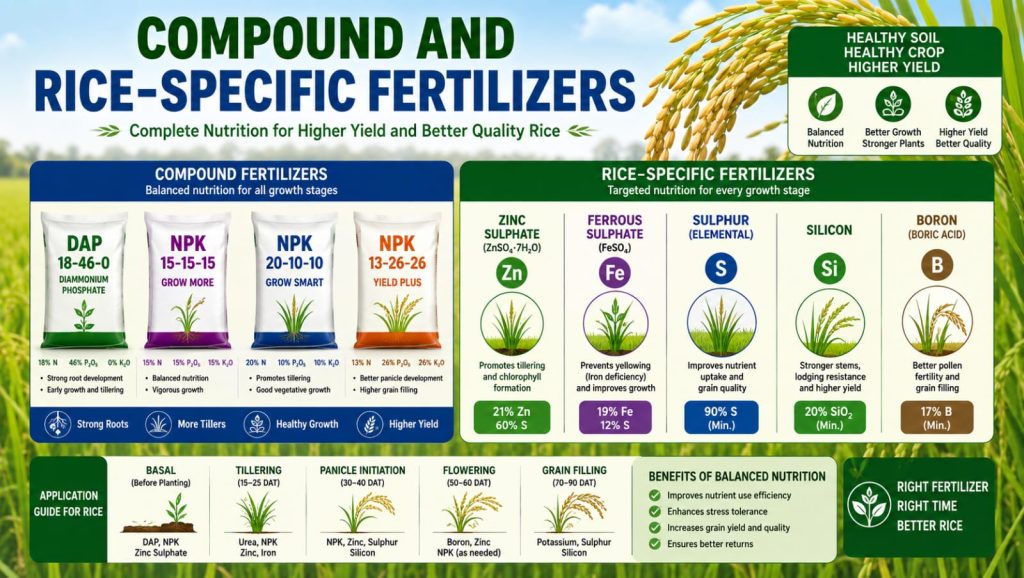
Compound fertilizer for rice provides two or more nutrients in one product, making fertilizer application easier and supporting balanced crop nutrition. NPK compound fertilizer, complete fertilizer, and rice-specific fertilizer may contain different nutrient ratios depending on soil and crop requirements. Common examples include 15-15-15 fertilizer and 17-17-17 fertilizer, while DAP and MOP can also be used together as an NPK fertilizer combination when separate nutrient sources are needed.
For rice farming, chemical fertilizer for rice, mineral fertilizer, water soluble fertilizer, and liquid fertilizer can be combined with organic fertilizer, organic manure, or farmyard manure (FYM). This approach, known as integrated nutrient management (INM), uses an organic and chemical fertilizer combination to improve nutrient availability and maintain soil fertility. The best fertilizer choice should be based on soil testing, rice nutrient requirements, and local fertilizer recommendations.
Unused semantic terms: None — all provided terms have been used naturally.
Fertilizer Application by Rice Growth Stage
Fertilizer needs change as rice develops through the seedling, vegetative, reproductive, and grain-filling stages. A practical program uses basal fertilizer application for early nutrition and timely nitrogen top dressing during active growth. The exact rates should be based on soil testing, variety, yield target, and local recommendations.
| Rice Growth Stage | Fertilizer Approach |
|---|---|
| Seedling stage | Use rice seedling stage fertilizer carefully for early establishment. |
| Transplanting | Apply fertilizer during transplanting as a basal fertilizer application where recommended. |
| Vegetative stage | Rice vegetative stage fertilizer supports leaf growth and crop establishment. |
| Active tillering | Apply rice tillering stage fertilizer or active tillering fertilizer, particularly nitrogen, according to crop need. |
| Panicle initiation | Panicle initiation fertilizer supports panicle development and is an important nitrogen application stage. |
| Booting & flowering | Booting stage fertilizer and flowering stage fertilizer should only be applied when required by the crop and local recommendation. |
| Grain filling | Grain filling fertilizer is used carefully because nutrient demand and fertilizer response vary by field and crop condition. |
Pre-plant fertilizer, pre-flood fertilizer, and top dressing fertilizer should be timed according to the establishment method and nutrient requirement. Nitrogen is commonly split between early growth, active tillering, and panicle initiation to improve nutrient uptake and fertilizer efficiency.
Unused semantic terms: None — all provided terms were used naturally.
Soil Testing and Fertilizer Selection
Soil testing for rice helps farmers understand the field’s nutrient needs before choosing fertilizer. A rice soil analysis can measure soil pH, soil fertility, available nitrogen, available phosphorus, and exchangeable potassium, giving a clear picture of the soil nutrient status. Soil testing is useful for identifying nutrient shortages and avoiding unnecessary fertilizer applications.
For better soil fertility management, fertilizer should be selected according to the test results and crop requirements. A fertilizer recommendation based on soil test can determine suitable amounts of nitrogen, phosphorus, and potassium, while soil nutrient testing and nutrient deficiency diagnosis help identify problems that may affect rice growth and yield. IRRI’s rice nutrient-management tools also use soil P, K, and pH information when developing crop recommendations.
Micronutrients for Rice
Micronutrients for rice are needed in smaller amounts but are important for healthy growth, enzyme activity, chlorophyll formation, and grain development. Zinc for rice is especially important because zinc deficiency in rice is one of the more common micronutrient problems. A suitable zinc fertilizer should be applied when soil or plant testing confirms a deficiency. Other important trace elements include boron for rice, iron for rice, manganese for rice, copper for rice, and molybdenum for rice, while sulfur for rice, magnesium for rice, calcium for rice, and silicon for rice also support overall plant nutrition.
Good rice micronutrient management starts with soil testing and correct micronutrient deficiency diagnosis rather than unnecessary applications. Zinc and sometimes sulfur deficiencies can be locally important, and their availability can be affected by soil conditions, flooding, pH, and interactions with other nutrients.
What is the best fertilizer for rice crop?
A balanced fertilizer containing nitrogen, phosphorus, and potassium (NPK) is generally effective. The best choice depends on soil fertility, rice variety, and crop nutrient requirements.
Is urea good for rice crops?
Yes. Urea contains 46% nitrogen and is widely used to support rice leaf growth, tillering, and yield. It is usually applied in split doses rather than all at once.
When should fertilizer be applied to rice?
Fertilizer is commonly applied at basal, tillering, and panicle initiation stages. Timing should be adjusted according to soil testing and local fertilizer recommendations.
Which NPK ratio is best for rice?
There is no single NPK ratio that is best for every rice field. The appropriate ratio depends on the soil nutrient status, yield target, and rice variety.
How can I improve fertilizer efficiency in rice farming?
Use soil testing, apply the recommended fertilizer rate, split nitrogen applications, and match nutrients with the crop’s growth stages. This can improve nutrient uptake and reduce fertilizer waste.