
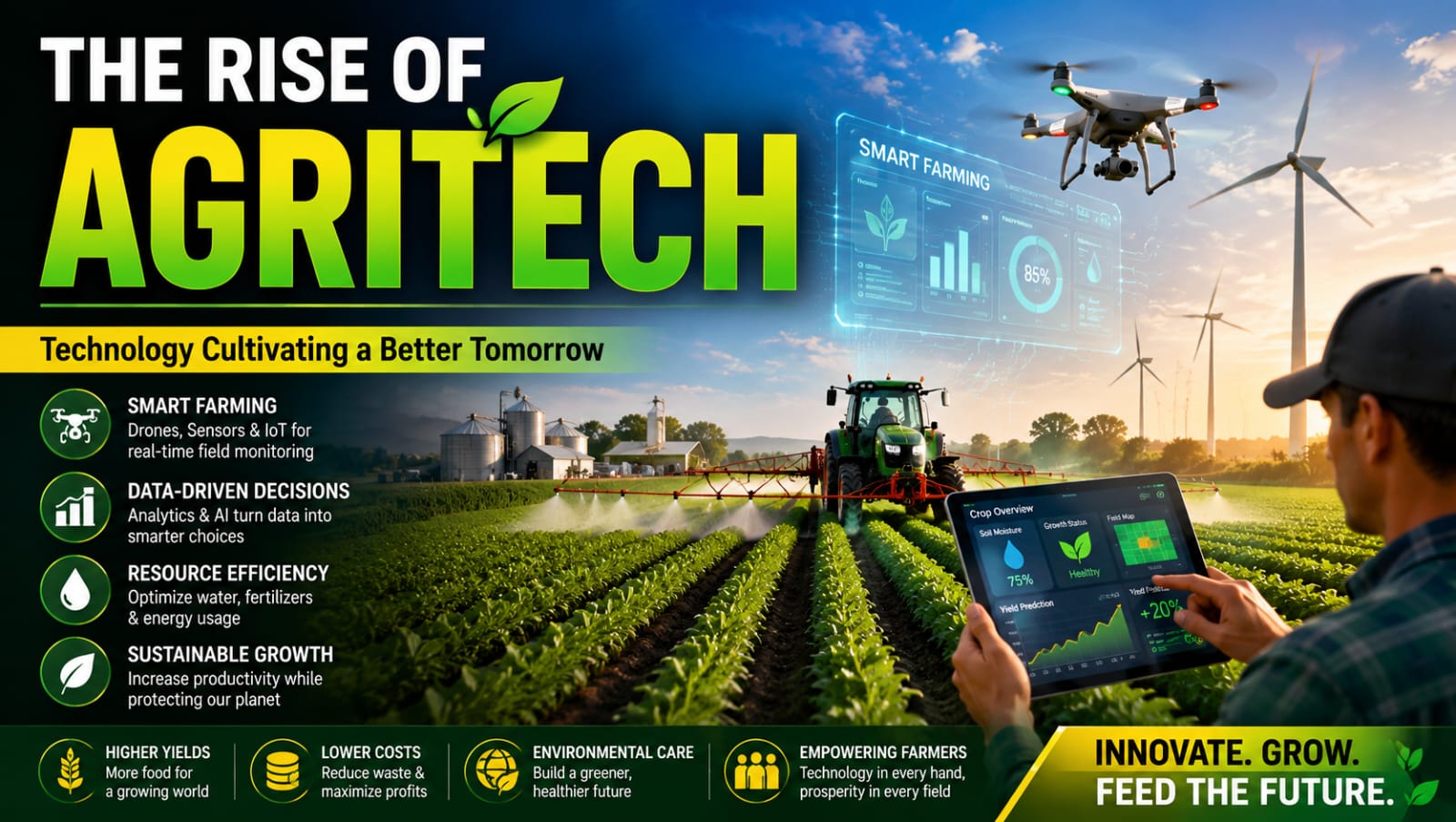
The Rise of AgriTech is changing modern agriculture by combining farming with advanced technology such as artificial intelligence, IoT, drones, sensors, data analytics, and precision agriculture. These innovations help farmers monitor crops, manage resources, improve productivity, and make better data-driven decisions.
The growing use of AgriTech is also helping address challenges such as climate change, water scarcity, labor shortages, and rising food demand. With smart farming, digital agriculture, automated machinery, and sustainable farming solutions, The Rise of AgriTech is creating a more efficient, productive, and resilient future for agriculture.
AgriTech Fundamentals
The Rise of AgriTech represents the growing use of AgriTech, agritech, agricultural technology, agriculture technology, and agtech to improve farming and food production. It includes digital agriculture, smart agriculture, smart farming, digital farming, and modern farming technology that help farmers use data, automation, sensors, and other innovative tools for better decisions and higher productivity.
This development is driving agricultural innovation, agricultural transformation, agricultural digitization, and technology-driven agriculture. Often linked with the agricultural revolution and fourth agricultural revolution, these advancements are shaping the future of agriculture by making modern farming more efficient, productive, sustainable, and resilient.
Smart Farming & Precision Agriculture
The Rise of AgriTech is making smart farming systems and precision agriculture more practical for modern farmers. Precision farming uses precision agriculture technology, farm intelligence, intelligent farming, and data-driven farming to analyze field conditions and improve farming decisions. Automated farming, connected farming, and digital farming solutions further help farmers manage crops and resources with greater accuracy.
Through smart farm management, farm optimization, agricultural efficiency, and better farm productivity, farmers can reduce waste and improve crop performance. Precision crop management and site-specific farming allow inputs to be applied according to the needs of specific areas, while farm monitoring and real-time farm monitoring provide timely information about crops, soil, weather, and field conditions.
Artificial Intelligence & Data Technologies
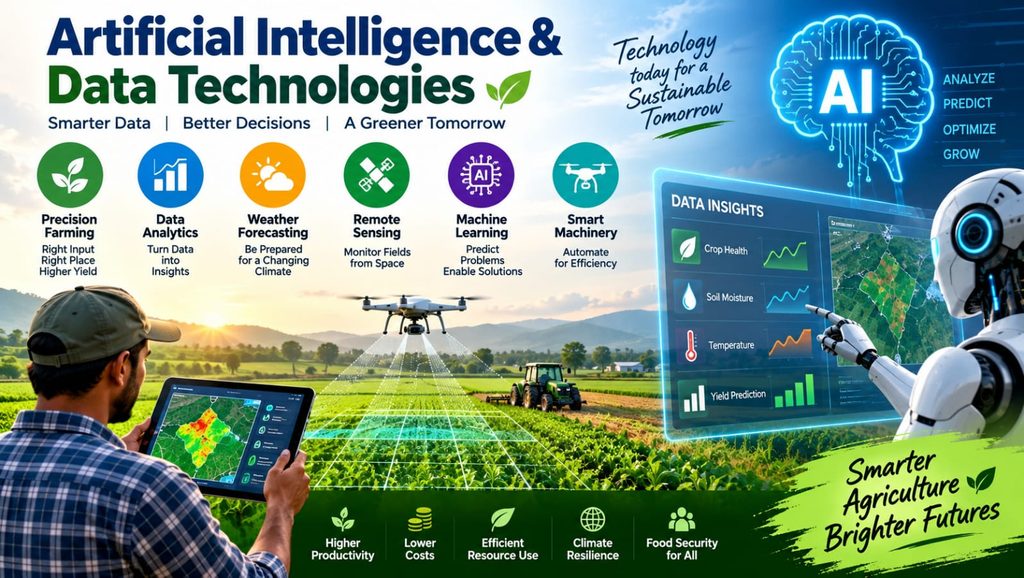
The Rise of AgriTech is accelerating the use of artificial intelligence and advanced data technologies in modern farming. AI in agriculture uses machine learning and ML in agriculture to analyze large amounts of agricultural data and farm data. Through big data analytics and data analytics, farmers can identify crop patterns, monitor field conditions, and improve resource management.
Predictive analytics, predictive models, and predictive agriculture can turn complex farm information into actionable insights and support better data-driven decisions. At the same time, digital agronomy and AI-powered farming are improving intelligent crop monitoring, helping farmers detect potential crop problems earlier and manage agricultural operations more efficiently.
IoT, Sensors & Connectivity
The Rise of AgriTech is expanding the role of the Internet of Things in modern farming. IoT in agriculture and agricultural IoT connect smart sensors, farm sensors, soil sensors, and environmental sensors to collect valuable information from fields. These connected devices support connected agriculture by helping farmers track soil moisture, temperature, weather conditions, and crop environments more efficiently.
Modern farms increasingly use wireless networks, LoRa technology, remote connectivity, and improved farm connectivity to transfer information across agricultural areas. Advanced sensor technology enables real-time monitoring, allowing farmers to receive timely updates and make better decisions about irrigation, crop health, resource use, and overall farm management.
Drones, Satellites & Remote Sensing
The Rise of AgriTech is making agricultural drones, farming drones, and advanced drone technology valuable tools for modern agriculture. Drone surveillance and drone monitoring provide detailed views of fields, while aerial imagery supports field surveillance, environmental scanning, crop mapping, terrain mapping, and field mapping. These technologies help farmers identify crop stress, assess field conditions, and improve crop monitoring.
At a larger scale, satellite imagery and satellite tracking provide valuable information across extensive agricultural areas. Remote sensing and remote sensing technology enable detailed aerial crop analysis, while hyperspectral imaging and infrared imaging can reveal crop and environmental conditions that may not be visible to the human eye. Together, satellite agriculture and these advanced monitoring technologies support more accurate and efficient farm management.
Farm Automation & Robotics
The Rise of AgriTech is helping farmers adopt farm automation, agricultural automation, and automated farming systems to reduce manual work and improve farm efficiency. Agricultural robotics, farm robots, autonomous farming, automated equipment, and robotic farming can perform repetitive tasks with greater consistency. Smart machinery, agricultural machinery, autonomous agricultural equipment, and other labor-saving technology are also making modern farm operations more efficient.
Guideful Steps for Farm Automation & Robotics
- Identify Farm Tasks: Start by identifying repetitive activities that can benefit from automation, such as irrigation, feeding, crop monitoring, and harvesting.
- Choose Suitable Technology: Select appropriate automated irrigation, automated pumps, automated feeding systems, or robotic equipment according to the farm’s specific needs.
- Automate Crop Management: Use automated crop management tools to monitor crops and manage routine agricultural activities more efficiently.
- Introduce Robotic Harvesting: Where suitable, use robotic harvesting systems to reduce labor requirements and improve harvesting efficiency.
- Connect Automated Operations: Integrate different technologies to create efficient automated farm operations and improve coordination across the farm.
- Monitor and Optimize: Regularly evaluate performance, maintenance needs, costs, and productivity to ensure the automation system delivers practical benefits.
see more:The Rise of AgriTech
Crop Monitoring & Farm Management
The Rise of AgriTech is improving how farmers observe crops and manage agricultural operations. Crop monitoring, crop growth monitoring, crop health monitoring, and crop surveillance provide valuable information about plant development and field conditions. Through crop analysis, field monitoring, crop diagnostics, and plant health monitoring, farmers can identify potential problems earlier and take timely action.
Modern farm management software, farm management systems, and digital farm management help organize field activities and agricultural data in one place. Technologies for disease detection, pest detection, soil quality monitoring, and environmental monitoring allow farmers to better understand crop and field conditions, improve resource use, and support healthier and more productive farming.
Sustainable & Climate-Smart Agriculture
The Rise of AgriTech is supporting sustainable agriculture, sustainable farming, and climate-smart agriculture by helping farmers produce food while protecting natural resources. Climate-resilient farming focuses on adapting agricultural systems to changing weather conditions, while environmental sustainability and sustainable farming practices promote responsible resource use. Technologies that support resource conservation, natural resource management, water conservation, and soil conservation can make farming more efficient and resilient.
Modern AgriTech also contributes to sustainable food production through low-impact farming, green agriculture, and eco-friendly farming approaches. Resource-efficient agriculture and sustainable agricultural technology can help achieve a reduced environmental impact while supporting climate change adaptation and long-term agricultural sustainability. Together, these approaches are shaping a more productive, resilient, and environmentally responsible agricultural future.
Vertical Farming & Alternative Growing Systems
The Rise of AgriTech is creating new possibilities for food production through vertical farming, vertical agriculture, urban farming, and urban agriculture. Indoor farming and controlled environment agriculture (CEA) allow crops to grow in carefully managed conditions where temperature, humidity, light, and nutrients can be controlled. Rooftop farming and container farming also provide practical options for producing food in areas where traditional farmland is limited.
Modern alternative systems such as aeroponics, hydroponics, desert agriculture, and seawater farming are expanding the possibilities of agricultural production. These alternative farming systems often use soilless farming and controlled growing environments to improve resource efficiency and enable crop production in challenging locations. Such innovations can support food production in cities, arid regions, and other areas where conventional farming is difficult.
see more:The Rise of AgriTech
Irrigation, Water & Resource Efficiency
The Rise of AgriTech is transforming irrigation and agricultural resource management by introducing smarter and more efficient ways to use water. Smart irrigation, precision irrigation, and automated irrigation systems use advanced irrigation technology to deliver water according to crop and soil requirements. Through improved water management and agricultural water management, farmers can adopt water-efficient farming methods that reduce unnecessary water loss. Water conservation technology, smart pumps, automated pump systems, irrigation sensors, and soil moisture sensors can continuously monitor field conditions and help farmers make timely irrigation decisions.
Modern systems support precision water application, ensuring that the right amount of water reaches the right area at the right time. This improves resource efficiency and promotes efficient water use, while helping achieve reduced water consumption without compromising crop growth. By combining sustainable irrigation with data-driven monitoring and agricultural resource management, AgriTech can help farmers conserve valuable water resources, reduce operational costs, and build more productive and environmentally responsible farming systems.
What is AgriTech in agriculture?
AgriTech refers to the use of modern technology in farming, including AI, IoT, smart irrigation, drones, sensors, robotics, and data analytics to improve agricultural productivity and efficiency.
How does AgriTech improve water efficiency?
AgriTech uses smart irrigation, soil moisture sensors, automated pumps, and precision water application to provide crops with the right amount of water and help reduce unnecessary water consumption.
What is precision irrigation?
Precision irrigation is a technology-driven method that delivers water to crops according to specific soil, weather, and crop requirements, improving water use and reducing waste.
Can AgriTech support sustainable agriculture?
Yes. The Rise of AgriTech is supporting sustainable agriculture by improving resource efficiency, conserving water and soil, reducing waste, and helping farmers make data-driven decisions.
What are the benefits of smart irrigation systems?
Smart irrigation systems can improve crop growth, reduce water consumption, lower irrigation costs, automate watering activities, and help farmers manage water resources more efficiently.



One Comment